

The Taj Mahal needs no introduction. Built by Mughal Emperor Shah Jahan in the 17th century as a monument to his beloved wife Mumtaz Mahal, it remains one of the most visited and photographed landmarks on earth. More than six to eight million visitors make the journey to Agra every year just to stand before it.
But here is what many first-time visitors miss: timing your visit correctly can make or break your entire experience. Show up on a Friday, and you will find the gates closed. Arriving at midday in June without knowing the summer schedule, and you may find yourself sweating through peak crowd hours. Plan for moonlight viewing without pre-booking, and you will be turned away at the gate.
This guide covers everything you need to know about Taj Mahal timings — opening and closing hours, seasonal changes, sunrise and sunset windows, moonlight viewing schedules, gate-by-gate entry guidance, and practical tips that will actually help you plan a smooth, memorable visit.
Slots fill up fast in peak season — secure your verified guide or tour today, one message away on WhatsApp.
💬 Chat on WhatsAppWhat Are the Taj Mahal Timings?
The Taj Mahal is open from sunrise to sunset, six days a week (closed on Fridays). The exact opening and closing times shift with the seasons because the monument follows natural daylight hours rather than fixed clock times.
As a general rule:
- Summer (April–September): Opens around 6:00 AM, closes around 7:00 PM
- Winter (October–March): Opens around 6:30 AM, closes around 6:00 PM
The gates open 30 minutes before official sunrise and close 30 minutes after sunset. This window is important — it is when the iconic golden light falls on the white marble, making it the most coveted time for photographers and casual visitors alike.
The Archaeological Survey of India (ASI), which manages the site, does not change operating hours based on holidays except for Friday closures and occasional national security events.
Taj Mahal Opening and Closing Time
Here is a quick reference for Taj Mahal entry timing by season:
| Season | Months | Opening Time | Closing Time |
|---|---|---|---|
| Summer | April – June | ~6:00 AM | ~7:00 PM |
| Monsoon | July – September | ~6:00 AM | ~6:30 PM |
| Autumn | October – November | ~6:00 AM | ~6:00 PM |
| Winter | December – February | ~6:30 AM | ~5:30 PM |
| Spring | March | ~6:00 AM | ~6:30 PM |
Note: These times are approximate and follow actual sunrise and sunset. Always verify the exact timings for your visit date through the ASI official portal or your tour operator, as they can shift by 10–15 minutes across months.
The last entry is typically 45 minutes before the official closing time. If you arrive at the gate close to sunset, staff may turn you away even if the site technically has minutes remaining.
Is the Taj Mahal Open Every Day?
No. The Taj Mahal is closed to tourists every Friday. This is a long-standing policy because the Arhai-Din-Ka-Jhonpra Mosque located within the complex holds Friday prayers, and the closure respects the sanctity of the religious gathering.
Local Muslim worshippers are permitted entry for prayers, but the monument and gardens remain off-limits for regular tourists throughout the day. It does not matter whether it is peak tourist season or not — the Friday closure is non-negotiable and applies throughout the year.
If your Agra itinerary only has one day and that day falls on a Friday, you need to rplan. Many travelers on a Same Day Agra Tour or a weekend Golden Triangle Tour have made this mistake and lost the opportunity entirely.
The Taj Mahal does remain open on all Indian public holidays including Diwali, Holi, Independence Day, and Republic Day — so those are not a concern.
Taj Mahal Sunrise Timing
Sunrise is, without question, the single best time to visit the Taj Mahal. If you can manage only one timing window during your trip, make it this one.
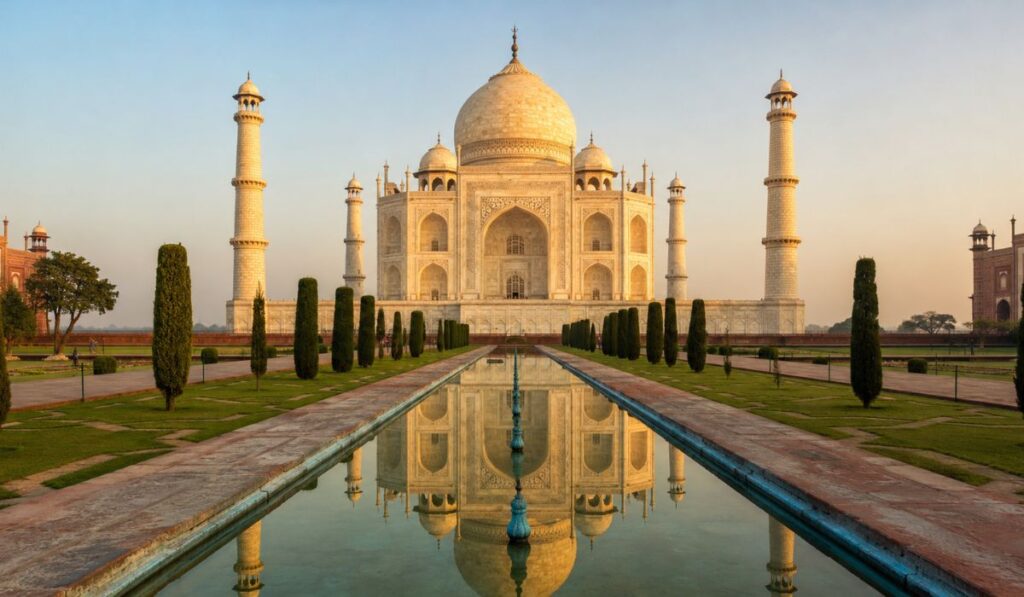
Why sunrise works so well:
First, the light. As the sun clears the horizon behind the Yamuna River, it casts a warm amber and rose-gold tone across the white Makrana marble. The dome appears to glow from within. The same monument that looks flat and bleached under the midday sun looks almost otherworldly at 6:30 AM.
Second, the crowds. Visitors who arrive at or just before the gate opening will find themselves in a nearly empty complex. The main pool reflection shot — the most photographed image in Indian tourism — is genuinely achievable without strangers walking through your frame.
Third, the temperature. In summer, the Taj Mahal complex can feel like a furnace by 10 AM. At sunrise, the air is still cool and the marble underfoot is comfortable to walk on in the socks you are required to wear near the mausoleum.
For photographers, the blue hour just before sunrise (about 20–30 minutes before gates open) is worth arriving early for. Set up outside the East Gate, and you will catch the dome silhouetted against a deep blue sky before the crowds arrive.
Taj Mahal Sunset Timing
Sunset at the Taj Mahal offers a different kind of beauty — deeper, more dramatic, and surprisingly less crowded than the morning rush.
As the light shifts from white to golden to amber in the final 90 minutes of the day, the marble shifts color in real time. The shadows lengthen, the ornamental gardens take on a cooler tone, and the reflected light off the Yamuna behind the monument creates a moody, cinematic backdrop.
From the western corner of the main terrace, the setting sun positions itself behind and to the side of the dome, creating strong sidelight that makes every carved detail — the calligraphy, the inlaid pietra dura floral work — stand out sharply.
Evening visitors also benefit from a more relaxed atmosphere. The tour groups that arrived at 9 AM are long gone. The complex feels more spacious. Many travelers who did the sunrise visit describe the sunset session as a welcome “second look” that reveals details they missed in the morning excitement.
Best Time to Visit the Taj Mahal
Best Time of Day
Sunrise, without exception. Arriving at gate opening — roughly 6:00–6:30 AM depending on the season — gives you golden light, thin crowds, and cool temperatures simultaneously. If sunrise is not possible, sunset is the next best window. Avoid 10 AM to 3 PM; the crowds peak, the light is harsh, and the heat (especially in summer) makes the visit exhausting.
Best Season
October through March is the ideal season for visiting the Taj Mahal. The weather is mild, the skies are generally clear, and the marble looks its most luminous against a blue winter sky. Temperatures range from a comfortable 8°C at night to around 25°C during the day — perfect for walking the expansive grounds.
Avoid April through June if heat is a concern. Temperatures routinely reach 40–45°C, and the direct sun on white marble creates a harsh, bleached look in photographs. Monsoon season (July–September) brings relief from the heat and occasional dramatic cloud skies, but also humidity, intermittent rain, and reduced visibility on foggy days.
Best Month
October, November, February, and March consistently offer the best combination of weather, visibility, and crowd levels. December and January are colder but still excellent, particularly for photography — the low winter sun creates long, dramatic shadows across the gardens even at midday. Note that December and January can also bring fog in Agra, which while beautiful in photographs, occasionally delays morning entry if visibility drops significantly.
Taj Mahal Moonlight Viewing Timings
The Taj Mahal offers a limited moonlight viewing program that allows visitors to see the monument after dark — one of the most exclusive and atmospheric experiences available in Indian tourism.

Moonlight viewing schedule:
- Available on: The full moon night + 2 nights before and 2 nights after (5 nights per month)
- Viewing hours: 8:30 PM to 12:30 AM (last entry at 12:00 midnight)
- Visitors are divided into batches of approximately 50 people
- Each batch gets roughly 30 minutes inside the complex
Booking is mandatory. Tickets for moonlight viewing must be purchased in advance through the ASI ticketing portal. Walk-in moonlight entry is not permitted. Tickets sell out quickly — especially for full moon nights — so book at least a week ahead during peak season.
Entry fee for moonlight viewing: ₹750 for Indian nationals; ₹750 + ₹200 (ASI surcharge) for foreign nationals (verify current rates before visiting, as ASI revises pricing periodically).
Important rules for moonlight visits:
- Photography is prohibited inside the complex during moonlight viewing
- Mobile phones must be kept in your pocket during the viewing window
- Only the exterior of the mausoleum and main terrace are accessible — no entry inside the main dome structure
- Moonlight viewing is suspended during Ramadan and on certain national occasions
The experience is quieter and more contemplative than the daytime visit. The white marble appears to emit a soft blue-white glow under a full moon, and the reflection pool captures a nearly perfect mirror image of the illuminated dome. If you are visiting during a full moon month on a Taj Mahal Tour Package, it is worth building this into your schedule.
Taj Mahal Entry Gates and Timings
The Taj Mahal complex has three public entry gates. All gates open and close at the same time, but they differ in convenience, crowd levels, and proximity to parking.
East Gate
The East Gate is the most commonly used entry point and handles the highest footfall. It is closest to the main Taj Ganj tourist area and most budget hotels. If you are arriving independently by auto-rickshaw or on foot from central Agra, you will likely enter here.
The downside: queue lengths at the East Gate are often the longest, especially between 9 AM and 1 PM.
West Gate
The West Gate is preferred by visitors arriving from upscale hotels along Fatehabad Road, those on private Agra tours, and travelers arriving in hired cars or taxis. The queue here is typically shorter than the East Gate, and the surrounding area is less chaotic.
For visitors on a Same Day Agra Tour by car from Delhi or Jaipur, the West Gate is usually the recommended entry point.
South Gate
The South Gate is the least-used of the three and is closest to the Shilpgram craft village and the Taj Mahal parking lot. It tends to have the shortest queues, but it is farther from most hotels and the general tourist zone. Visitors who want to avoid crowds during peak hours should consider this gate.
All three gates have the same security screening setup: baggage X-ray, personal security check, and ticket verification before entry.
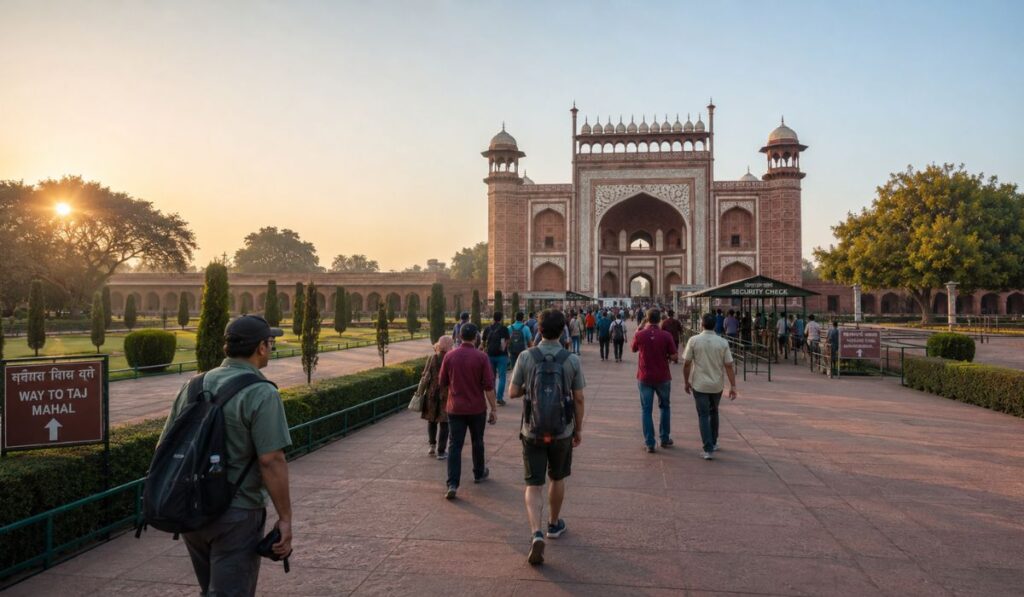
How Early Should You Reach the Taj Mahal?
Plan to arrive at the gate at least 30–45 minutes before opening time if you want to be among the first visitors inside.
Here is why the buffer matters:
Security check: Every visitor passes through an airport-style security screening. Bags are X-rayed, food and certain items are confiscated, and you will walk through a metal detector. With a large queue, this process alone can take 20–30 minutes.
Ticket verification: Tickets (online or printed) are scanned at the gate. During peak season, the scanning queue adds another 10–15 minutes.
Walking distance: From the gate to the main mausoleum is roughly 500–700 metres of pathway. At sunrise, this walk takes about 10 minutes at a comfortable pace.
Bottom line: if gates open at 6:00 AM and you want to be standing at the reflecting pool at 6:15 AM, get to the gate by 5:30 AM. During peak tourist months (October–March), many experienced guides recommend arriving even earlier — 5:00 to 5:15 AM — to beat the pre-opening queue.
Important Visitor Tips
What you can bring in:
- Water in a transparent PET bottle (up to 500ml; larger bottles may be confiscated)
- Camera without tripod (tripods are not permitted inside)
- Small handbag or daypack
- Prescribed medications with packaging
What is not allowed:
- Food of any kind (including packaged snacks)
- Tripods and selfie sticks
- Tobacco, pan masala, or gutka
- Power banks (check latest ASI rules — policies have changed in recent years)
- Drones or aerial photography equipment
- Pets
Photography tips:
- The reflection pool shot is taken from the central walkway, about 60–70 metres from the main gate inside
- For a crowd-free frame, shoot within the first 20 minutes of opening
- The interior of the mausoleum has low light — use a wide aperture or push ISO rather than flash (flash is prohibited)
- The best full-monument shot from a distance is from the Mehtab Bagh across the Yamuna River
Dress code: There is no strict dress code for tourists, but modest clothing is recommended out of respect. Shoes must be removed (or shoe covers worn) when stepping onto the main marble plinth. Complimentary shoe covers are provided at the base of the plinth.
Beat the crowds: Weekdays are consistently less crowded than weekends. Wednesday and Thursday are typically the quietest days. School and public holidays bring large domestic tour groups that can make the main terrace feel congested by mid-morning.
Frequently Asked Questions
1. What is the opening time of the Taj Mahal?
The Taj Mahal opens at sunrise, which varies by season. In summer (April–September), the gates open at approximately 6:00 AM. In winter (October–March), opening time is around 6:30 AM. Gates open 30 minutes before official sunrise, so the precise time shifts slightly each month. Always check the exact time for your specific visit date.
2. What is the closing time of the Taj Mahal?
The Taj Mahal closes at sunset. In summer, this is approximately 7:00 PM; in winter, around 5:30–6:00 PM. The last entry is typically 45 minutes before the official closing time, so do not plan to arrive close to sunset if you want adequate time inside. Arriving at least 90 minutes before closing is recommended.
3. Is the Taj Mahal open on Friday?
No. The Taj Mahal is closed to tourists every Friday without exception. The closure is due to Friday prayers held at the mosque within the complex. Local worshippers may enter for religious observance, but the monument and gardens remain closed to regular visitors the entire day. Plan your Agra trip carefully to avoid a Friday visit.
4. What is the best time to visit the Taj Mahal?
Sunrise is the best time to visit — the light is golden, the crowds are minimal, and the temperature is comfortable. For the best season, October to March offers cool weather and clear skies. The best months are October, November, February, and March. Avoid summer afternoons (10 AM–3 PM) when heat and crowds peak simultaneously.
5. Can tourists visit the Taj Mahal at night?
Yes, but only through the official moonlight viewing program. Night visits are available on the full moon night and the two nights before and after (five nights per month). Tickets must be pre-booked through the ASI portal. Viewing time is 8:30 PM to 12:30 AM, with batches of 50 visitors allowed in at a time. Photography is prohibited during moonlight viewing.
6. How much time is required to explore the Taj Mahal?
Most visitors need 2 to 3 hours for a comfortable, unhurried visit. This includes time to explore the main garden, photograph the reflecting pool, walk the main terrace, enter the mausoleum, visit the mosque and guest house (jawab), and exit. History enthusiasts or photographers often spend 3–4 hours. A rushed visit can be done in 90 minutes, but it is not recommended.
7. Which gate is best for entering the Taj Mahal?
For independent travelers arriving from Taj Ganj hotels, the East Gate is most convenient. For those arriving by private car or taxi, the West Gate usually has shorter queues and smoother access. The South Gate is the quietest option for those arriving from the parking area near Shilpgram. If crowd avoidance is the priority, the South Gate during early morning hours is the best bet.
8. Does the Taj Mahal timing change in winter?
Yes, the Taj Mahal timings shift in winter. Because the site opens at sunrise and closes at sunset, and winter days are shorter, the effective visiting window narrows. In December and January, the complex may open around 6:30 AM and close as early as 5:30 PM. Winter mornings can also bring fog in Agra, which occasionally delays entry but can create dramatic, atmospheric photography conditions.
Plan Your Taj Mahal Visit the Right Way
The Taj Mahal is one of those rare places that rewards preparation. Knowing the correct opening times, planning around the Friday closure, booking moonlight viewing tickets in advance, and choosing the right gate and time of day can transform a stressful, crowd-heavy visit into something genuinely unforgettable.
To summarize the key timings:
- Daily opening: Sunrise (approx. 6:00–6:30 AM depending on season)
- Daily closing: Sunset (approx. 5:30–7:00 PM depending on season)
- Closed: Every Friday
- Moonlight viewing: 8:30 PM–12:30 AM on full moon and adjacent nights (pre-booking mandatory)
- Best time of day: Sunrise
- Best season: October to March
Whether you are booking a Taj Mahal Sunrise Tour for an early morning first look, exploring Agra as part of a Golden Triangle Tour, or combining it with a broader India itinerary, getting the timing right is the single most impactful thing you can do before you arrive.
The Taj Mahal rewards patience and planning in equal measure. Visit at the right hour, in the right season, and it will give you something that no photograph — however technically perfect — can fully replicate.
Planning a trip to Agra? Explore our Same Day Agra Tour, Taj Mahal Sunrise Tour, Golden Triangle Tour, and Taj Mahal Tour Packages for expertly guided visits that take the guesswork out of timing.
Comments