
Slots fill up fast in peak season — secure your verified guide or tour today, one message away on WhatsApp.
💬 Chat on WhatsAppIntroduction: When Agra Comes Alive After Dark
I’ve been to Agra three times. The first two visits were the usual story — rush to the Taj Mahal at sunrise, squeeze through the crowds, grab a few photos, and leave by afternoon. Standard Golden Triangle stuff.
But on my third trip, I stayed until evening.
A local guide I’d befriended over chai told me something that changed my entire plan: “Sahib, Agra ka asli rang raat ko dikhta hai.” The true colours of Agra reveal themselves at night.
He wasn’t wrong.
That evening, I walked into Agra Fort just as the sun dropped behind the red sandstone walls. The crowds had thinned. The light was turning golden. And then — the show began.
Rang-e-Agra: Yugon Ka Safar.
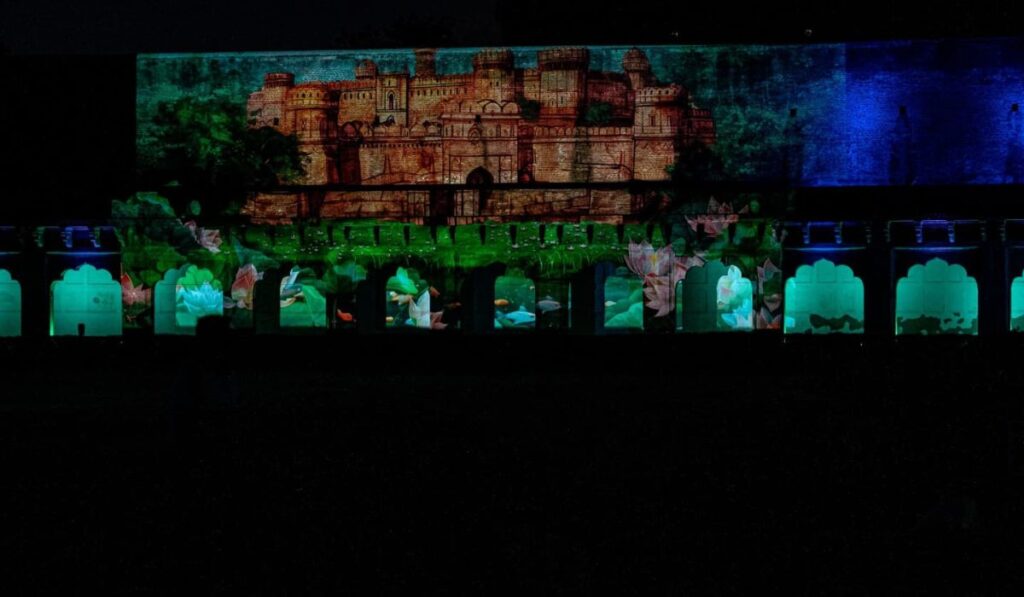
For the next 70 minutes, I sat completely still. The fort walls lit up in colours I hadn’t imagined. A voice filled the air. Mughal emperors walked through history right in front of me. By the end, I had goosebumps.
If you’re planning a trip to Agra and skipping this show, you’re missing the best part.
This guide covers everything — timings, tickets, what to expect, how to book, and why this show deserves a permanent spot on every Agra itinerary.
What Is the Agra Fort Light and Sound Show?
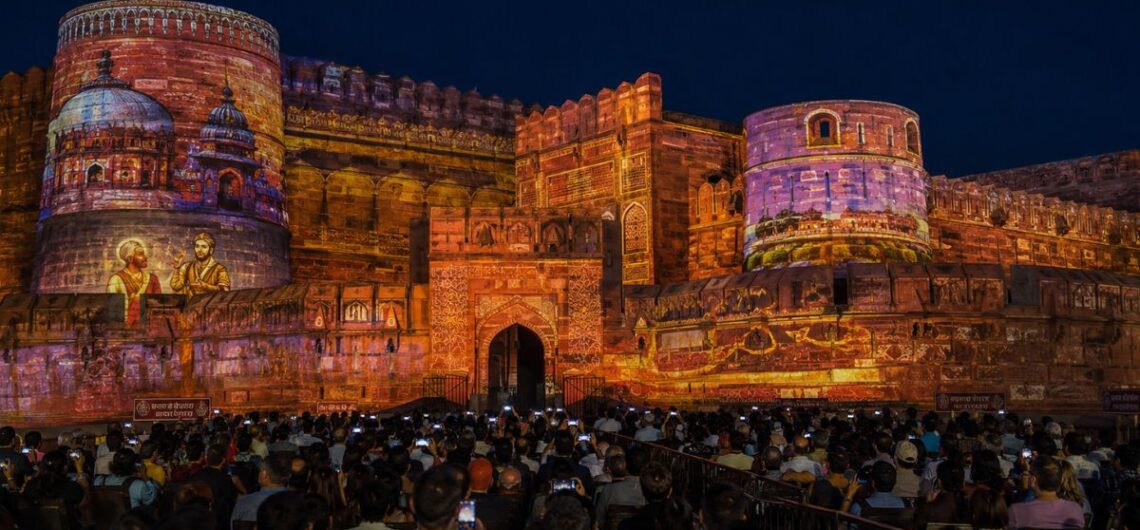
The Agra Fort Light and Sound Show is a professionally produced multimedia experience held inside the Agra Fort complex every evening. It uses dramatic lighting, projection mapping, narration, and music to bring the fort’s 500-year-old Mughal history to life.
The show is officially named Rang-e-Agra: Yugon Ka Safar, and it runs in both Hindi and English sessions. It’s produced by the Archaeological Survey of India (ASI) in partnership with the Uttar Pradesh Tourism Department.
Think of it as a 70-minute walk through Indian history — without leaving your seat.
What Does “Rang-e-Agra: Yugon Ka Safar” Mean?
The name is Urdu and Hindi, and it translates beautifully into English:
- Rang-e-Agra = The Colours of Agra
- Yugon Ka Safar = A Journey Through the Ages
Together: The Colours of Agra: A Journey Through the Ages.
This title perfectly captures what the show is. It’s not just a history lesson. It’s a sensory experience that paints Agra’s story in light, sound, and emotion — moving across centuries from ancient kingdoms to modern times.
The name was chosen deliberately to reflect both the visual spectacle (rang = colours) and the historical sweep (yugon ka safar = journey through eras). Every dynasty that shaped Agra gets its moment in the spotlight — quite literally.
History Behind the Show: Why Was It Created?
Agra Fort is one of India’s most significant monuments. A UNESCO World Heritage Site, it was the primary residence of Mughal emperors before Shahjahanabad (Old Delhi) was built. Emperors Akbar, Jahangir, and Shah Jahan all ruled from within these walls.
Yet for decades, Agra’s tourism story revolved almost entirely around the Taj Mahal. Visitors would arrive, see the Taj, and leave. The fort — despite being extraordinary — played second fiddle.
The Light and Sound Show was introduced to change that. The goal was to support Agra Night Tourism and give visitors a reason to stay after sunset. It worked. The show has helped shift Agra’s image from a half-day Taj visit to a full destination experience.
For travellers, it means more depth. For Agra, it means longer stays, more spending, and wider appreciation of a city whose history goes far beyond one marble monument.
What Story Does the Show Tell?
The show covers roughly 2,500 years of Agra’s history across distinct eras. Here’s what each section explores:
Ancient Agra and Early Kingdoms
The show opens in antiquity. Agra’s origins as a settlement on the banks of the Yamuna are traced back through pre-Mughal rulers. The Lodi dynasty, which built an early fort at this site in the 15th century, gets brief but meaningful attention.
The Mughal Arrival and Akbar’s Reign
This is where the show really gains momentum. Emperor Akbar chose Agra as his capital and commissioned the construction of the current fort in red sandstone between 1565 and 1573. His story — military campaigns, his vision for a unified empire, his philosophy of religious tolerance — is told with remarkable energy. The lighting during this section is warm and powerful, matching Akbar’s personality.
Jahangir’s Era
Akbar’s son Jahangir is often overlooked in popular history, but this show gives him his due. His love of art, his famous justice chain (the Zanjir-e-Adl), and his troubled relationship with Shah Jahan are woven into the narrative.
Shah Jahan and the Taj Mahal
This is the emotional centrepiece of Rang-e-Agra. Shah Jahan’s reign — his architectural obsession, his profound love for Mumtaz Mahal, and the construction of the Taj Mahal as a monument to grief — is portrayed with deep feeling. The narration slows here. The music softens. And when the lights hit the fort walls in white and silver to evoke the Taj’s marble, there’s not a dry eye in the audience.
What makes this section particularly poignant is the reminder that Shah Jahan spent the last eight years of his life as a prisoner in Agra Fort — held captive by his own son Aurangzeb — with a direct view of the Taj Mahal across the Yamuna. He could see his greatest creation, but never reach it.
The British Period
The show doesn’t shy away from colonial history. The British use of Agra Fort as a military garrison, the events of 1857, and the impact of colonial rule on the fort’s structure and purpose are covered honestly.
Modern Agra
The final section celebrates independent India’s efforts to preserve and present this heritage to the world. It ends on a forward-looking note — Agra as a living city, not just a museum.
What Is the Experience of Watching the Show Like?
Let me be honest: no amount of description fully prepares you.
The show takes place in the open-air courtyard inside Agra Fort. You sit on tiered, covered seating facing the illuminated fort structures. There’s no screen — the fort itself is the screen.
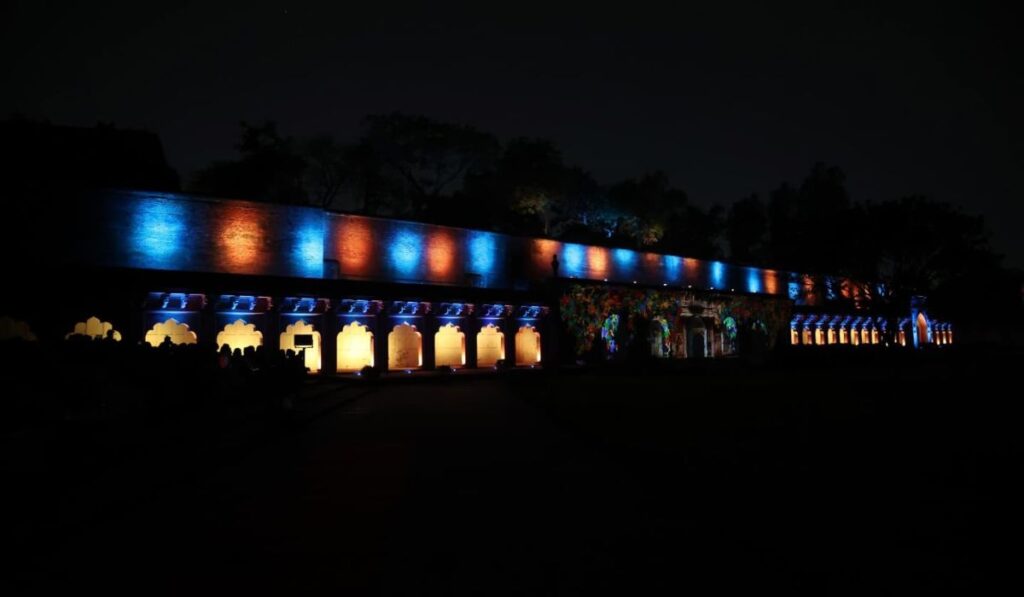
Lighting: The effects are sophisticated. Colours shift from amber to deep red to cool blue as eras change. The transition from Akbar’s red-sandstone warmth to Shah Jahan’s white-marble grief is particularly effective.
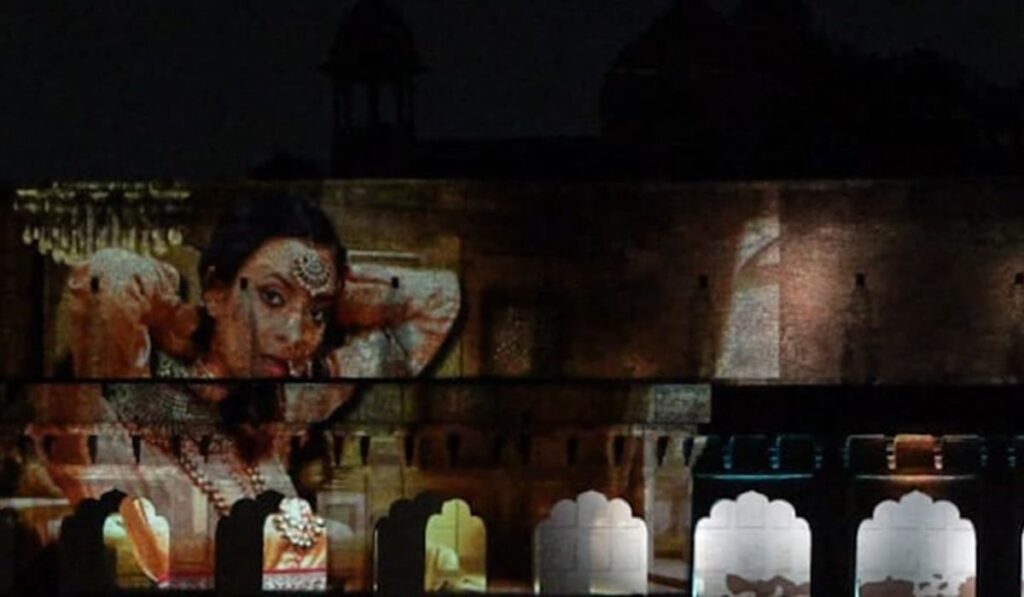
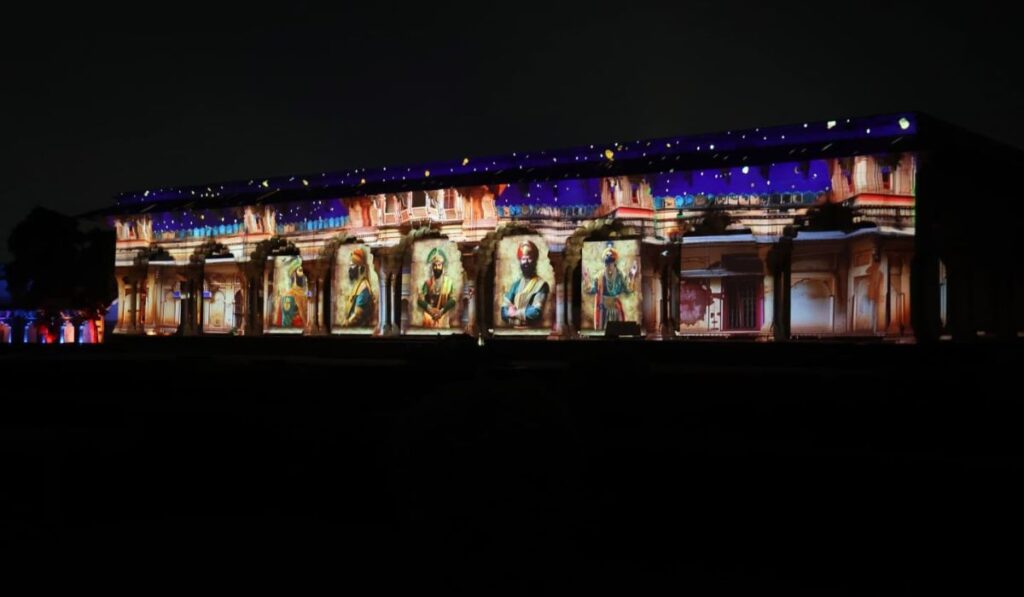
Projection Mapping: Images, maps, and historical illustrations are projected directly onto the fort walls, scaling to fit the architecture perfectly. Mughal miniature paintings appear on the actual surfaces of 16th-century stone.
Narration: The commentary is available in both Hindi and English. The voice acting is professional and evocative — not the flat, textbook delivery you might fear. It feels like a storyteller, not a textbook.
Music: The background score blends classical Hindustani compositions with period-appropriate instrumentation. During Shah Jahan’s segment, there’s a haunting use of the sarangi that I still remember.
Atmosphere: This is the unexpected part. Sitting inside a 450-year-old fort after dark, surrounded by illuminated Mughal architecture, the setting does half the work. The show is impressive anywhere; inside Agra Fort, it becomes something else entirely.
How Is This Show Different from Other Light and Sound Shows in India?
India has several well-known light and sound shows — at Red Fort in Delhi, Golconda Fort in Hyderabad, and Chittorgarh, among others. Having attended a few of these, I can say Rang-e-Agra stands apart for a few reasons:
1. The Setting Is Unmatched Agra Fort is a UNESCO World Heritage Site with extraordinary architectural detail. The diwan-i-aam, the diwan-i-khas, the imposing gateways — the show uses all of it. Other venues simply can’t match this visual canvas.
2. The Emotional Depth Most light and sound shows lean heavily on facts and dates. This one prioritises emotion. The Shah Jahan segment, in particular, has a narrative weight you rarely find in government-produced heritage shows.
3. The Bilingual Depth Both the Hindi and English versions are genuinely well-written — not just translated from each other. The English version has been crafted to communicate nuance to international visitors unfamiliar with Mughal history.
4. The Proximity to the Taj Mahal No other light and sound show in India takes place within a kilometre of a wonder of the world. The Taj Mahal is visible from parts of the fort grounds during the show. That context alone makes this experience unique.
Agra Fort Light and Sound Show Timings
| Season | Hindi Show | English Show |
|---|---|---|
| October – February | 7:30 PM | 8:45 PM |
| March – April | 7:30 PM | 8:45 PM |
| May – August | 8:00 PM | 9:00 PM |
| September | 7:30 PM | 8:45 PM |
Note: The show runs daily except on days of national mourning or maintenance closures. Always verify current timings through the official UP Tourism website or at the fort ticket counter before your visit, as schedules may be adjusted for festivals and special events.
Duration: Approximately 60–70 minutes.
Agra Fort Light and Sound Show Ticket Price
| Category | Ticket Price |
|---|---|
| Indian Adults | ₹50 per person |
| Indian Children (under 15) | ₹30 per person |
| Foreign Nationals | ₹200 per person |
| Students (with valid ID) | ₹30 per person |
Note: Entry to the fort complex itself (daytime admission) is separate from the show ticket. If you are visiting specifically for the evening show, you will need a show ticket. Prices are subject to revision — confirm current rates on-site or via the UP Tourism portal.
How to Book Tickets for the Agra Fort Light and Sound Show
Step 1: Online Booking (Recommended)
Visit the official Uttar Pradesh Tourism website or the Archaeological Survey of India portal. Look for the “Sound and Light Shows” section and select Agra Fort.
Step 2: Select Your Date and Language
Choose your preferred date and the language version — Hindi or English. Book at least 24–48 hours in advance, especially during peak season (October to March) when seats fill quickly.
Step 3: Payment
Pay via debit/credit card, net banking, or UPI. You’ll receive a confirmation email or SMS with a QR code.
Step 4: At the Fort
Arrive at the Amar Singh Gate (the main tourist entrance) at least 30 minutes before showtime. Carry your QR code on your phone or as a printout. The show entry gate is separate from the daytime entrance.
Step 5: Offline / On-Site Booking
If you haven’t booked online, head to the ticket counter at the Amar Singh Gate. Counters typically open 90 minutes before show time. Cash and digital payments are generally accepted, but availability is not guaranteed during peak season.
Best Time to Visit Agra Fort Light and Sound Show
The show runs year-round, but certain times are noticeably better:
October to March is the ideal window. The weather is cool, evenings are comfortable, and the October–November and February–March periods align with peak India tourism season. The fort looks spectacular in the cooler air.
December is particularly atmospheric. The combination of winter fog rolling off the Yamuna, the illuminated fort, and the Mughal narrative creates an almost cinematic experience.
Avoid peak summer (May–June) if you’re sensitive to heat. The show is outdoors, and evenings in Agra can still be quite warm during these months. Carry water and wear light, breathable clothing.
Monsoon (July–August) sessions sometimes get disrupted by rain. Check local weather forecasts if you’re visiting during this period.
How to Reach Agra Fort
From Delhi
- By Train: The Gatimaan Express (Delhi Hazrat Nizamuddin to Agra Cantt) is the fastest option at around 1 hour 40 minutes. The Shatabdi Express and several other trains also connect the two cities. Agra Fort Railway Station is even closer to the monument — just a 10-minute walk.
- By Road: Delhi to Agra via the Yamuna Expressway takes approximately 3–3.5 hours by car. Several bus services, including AC Volvo coaches, run this route regularly.
- By Air: Agra has a civil airport (Agra Airport / Pandit Deen Dayal Upadhyay Airport), but connectivity is limited. Most travellers fly into Delhi and travel by road or rail. For a full overview of Agra as a destination, Incredible India is a useful starting point for planning.
From Agra Cantt Railway Station
Agra Cantonment is the main railway station in the city. From here, Agra Fort is about 5–6 kilometres away. Auto-rickshaws, e-rickshaws, taxis, and app-based cabs are all readily available. Budget around ₹100–₹200 for an auto-rickshaw.
From the Taj Mahal
The Taj Mahal and Agra Fort are roughly 2.5 kilometres apart. You can walk the route along the Taj Mahal Eastern Gate to Agra Fort in about 25–30 minutes, or take a short auto-rickshaw ride for ₹50–₹80. Many visitors combine both in a single day — Taj Mahal in the morning, Agra Fort in the evening for the show.
Nearby Attractions to Combine With the Show
Taj Mahal
The logical pairing. Visit at sunrise for the most crowd-free experience, then return to the area in the evening for the light and sound show. The two sites together form the core of any serious Agra itinerary.
Mehtab Bagh
Located directly across the Yamuna River from the Taj Mahal, Mehtab Bagh (Moonlight Garden) offers one of the cleanest sunset views of the Taj. Visit around 5–6 PM before heading to the show. The silhouette of the Taj against an orange sky from this garden is genuinely extraordinary.
Itimad-ud-Daulah (Baby Taj)
Built between 1622 and 1628, this mausoleum is often called the “Baby Taj” and is considered a forerunner to the Taj Mahal in terms of marble inlay craft. It’s about 3 kilometres from Agra Fort. Worth a visit in the late afternoon.
Agra’s Local Markets
Sadar Bazaar and Kinari Bazaar are worth exploring after the show if you’re in the mood for late-night street shopping. Agra is famous for its marble inlay work (pietra dura), leather goods, and the famous Agra petha (a sweet made from ash gourd). Most shops stay open until 9–10 PM.
Is the Agra Fort Light and Sound Show Worth Watching?
Honestly? Yes — with a small caveat.
If you’re a first-time visitor to Agra, this show is absolutely worth your evening. It transforms what could be a dry monuments-and-dates experience into something genuinely moving. The combination of the fort’s physical presence, the lighting, and the Shah Jahan story creates a memory that lasts well beyond the trip.
If you’ve already visited Agra Fort during the day, the show adds an entirely different dimension. Seeing the same structures illuminated and narrated at night feels like visiting a different place.
The caveat: the production quality, while good, is not world-class. Some of the older projectors show their age. The narration occasionally over-explains points that the visuals already convey. But these are minor complaints against the backdrop of an experience that regularly reduces audiences to silence.
At ₹50–₹200 per ticket, the value is exceptional by any measure.
Travel Tips for Visitors
Here’s a practical checklist for the best experience:
- Book tickets in advance during October–March. Seats fill quickly on weekends.
- Arrive 30 minutes early to find good seats. The middle rows of the covered seating are ideal.
- Wear comfortable shoes. You’ll walk on uneven stone surfaces to reach the seating area.
- Bring a light jacket or shawl from October to February. Evenings get cold, especially near the river.
- Carry water and a snack. Food stalls near the fort can be chaotic in the evening.
- Download an offline map of Agra or keep your phone charged — navigation around the fort area is easier with GPS.
- Visit the Taj Mahal the same day if time allows. Sunrise Taj + evening fort show is one of the best single-day heritage experiences in India.
- Note the language session timing. English and Hindi shows run at different times. Confirm which session you’ve booked.
Common Mistakes Tourists Make
1. Showing up without a ticket in peak season. October to February is busy. Without advance booking, you may find the show sold out, especially on weekends and holidays.
2. Confusing the show entry with the daytime fort entrance. The show has a separate entry point. Ask specifically for the “Sound and Light Show” entrance when you arrive.
3. Leaving immediately after the show. The Agra Fort area at night has a distinct atmosphere. Take a few minutes to walk near the fort walls after the show — the illumination continues for a while and the crowds thin out rapidly.
4. Assuming the show runs every night without checking. The show is occasionally cancelled for national mourning periods, maintenance, or special government events. Always confirm before your visit.
5. Underestimating travel time from the Taj Mahal. Even a 2.5 km distance can take 20–30 minutes by auto-rickshaw in Agra’s evening traffic. Leave sufficient time.
Photography Rules
Photography inside the show area is generally permitted for personal use without flash or tripod. However:
- Commercial photography and videography require prior written permission from the ASI.
- Flash photography is prohibited as it disturbs other audience members and disrupts the mood of the show.
- Tripods are not allowed inside the seating area during the show.
- Some performers and staff may request that you lower your phone during key narrative moments — please cooperate. It’s genuinely worth watching without a screen in front of you.
For the best shots, wait for the intense colour changes during scene transitions. The fort walls photographed against a dark sky during the deep red Akbar sequence or the white Shah Jahan segment produce striking images.
Facilities Available at the Show
- Covered seating with numbered rows for all ticket holders
- Washrooms near the Amar Singh Gate entrance area
- Drinking water available near the entrance (carry your own for convenience)
- Wheelchair access is limited — the approach to the seating area involves some stone steps; contact UP Tourism in advance if assistance is required. For general travel advisories and visitor guidelines, India.gov.in carries official government travel information.
- Security personnel are present throughout
- First aid is available at the main entrance
- Souvenir stalls near the exit area sell books, postcards, and Agra-themed crafts
Why Every Tourist Should Watch Rang-e-Agra: Yugon Ka Safar
India has a thousand monuments. Many are magnificent. But very few tell their own story.
Agra Fort does, through this show, in a way that no guidebook can replicate. You’re not reading about Shah Jahan imprisoned in his own fort, watching the Taj Mahal from his window. You’re sitting inside that fort, in the dark, with the actual walls around you, and a voice is making you feel the weight of that solitude.
That’s what Rang-e-Agra does that a morning visit cannot.
It also corrects an imbalance. Too many visitors leave Agra thinking the Taj Mahal is the only story worth knowing. This show reminds you — quietly, beautifully, powerfully — that the Taj is the end of one man’s story, but Agra Fort is the stage on which centuries of India’s history played out.
If you care about India, history, or simply great storytelling, this show belongs on your list.
Agra Night Tourism: Why More Travellers Are Staying After Sunset
For years, Agra was a city that tourists passed through. Arrive by 6 AM, see the Taj Mahal, tick the box, leave by noon. The city barely had time to introduce itself.
That’s changing — and changing fast.
Agra’s night tourism ecosystem has grown significantly over the last few years, and the Rang-e-Agra show is at the centre of that shift. But it’s not just about one show. It’s about an entire evening economy that now gives travellers genuine reasons to stay.
The Night Economy Hotels near the Taj Mahal Ganj and Fatehabad Road are reporting longer average stays. Restaurants with rooftop Taj views are fully booked by 8 PM on most evenings from October to March. Street food vendors, souvenir stalls, and local craftsmen all benefit when tourists stop rushing out at sunset. A single evening well-spent in Agra generates more economic activity for the city than three hurried daytime hours.
Heritage Experiences After Dark The Light and Sound Show is the anchor, but there’s a growing movement to activate other heritage sites in the evening. Mehtab Bagh, which offers the cleanest sunset view of the Taj Mahal, has extended its hours. Night viewing of the Taj Mahal itself — available on five nights around the full moon each month — has been a popular programme for years, though tickets sell out extremely fast. These experiences collectively make Agra feel less like a monument checkpoint and more like a heritage destination.
Evening Attractions That Reward the Patient Traveller There’s a certain quality to Agra after 6 PM that daytime visitors simply never experience. The heat drops. The crowds thin. The light on the Taj Mahal turns from brilliant white to a warm, shadowed gold. Street chai tastes better. The city’s residents come out — not just tourists. Spending an evening here gives you access to a version of Agra that most people have never seen.
Local Markets at Night Sadar Bazaar and Kinari Bazaar are most alive after sunset. Marble inlay shops stay open late for serious buyers. The famous Agra petha shops are worth visiting — Panchi Petha is the most well-known brand. Evening shopping in Agra has a relaxed, unhurried quality that daytime tourist-zone crowds make impossible.
Cultural Shows and Performances Beyond the fort show, Agra occasionally hosts cultural evenings, classical music performances, and craft demonstrations at various heritage hotels and cultural centres. These are worth checking on arrival, particularly during winter festival season. The city has far more cultural depth than its standard tourist itinerary suggests.
The short version: if you’re only spending half a day in Agra, you’re seeing the monument. If you stay for the evening, you actually get to know the place.
Things to Do in Agra at Night
Agra after sunset is a different city. Here are the best ways to spend your evening:
1. Watch the Agra Fort Light and Sound Show This is the non-negotiable. Rang-e-Agra: Yugon Ka Safar runs every evening in Hindi and English sessions and is the finest heritage evening experience in Agra. Book your tickets in advance and arrive early for good seats.
2. Visit Mehtab Bagh at Sunset The Moonlight Garden on the opposite bank of the Yamuna offers an unobstructed sunset view of the Taj Mahal. Go between 5:00–6:30 PM before heading to the fort show. The view of the Taj silhouetted against an orange sky from here is one of Agra’s most underrated experiences.
3. Explore Sadar Bazaar Agra’s most tourist-friendly market comes alive in the evening. Browse marble inlay souvenirs, leather goods, and local textiles. Bargaining is expected. The lanes around the main market also have excellent street food — try the bedai sabzi (a local breakfast-style snack that stalls serve throughout the day and evening) and the chaats near the clock tower.
4. Rooftop Dining Near the Taj Mahal Several restaurants along Taj Ganj and Fatehabad Road offer rooftop seating with views of the Taj Mahal illuminated at night. The Taj itself glows under artificial lighting in the evenings, and a meal with that backdrop is genuinely memorable. Restaurants worth checking include Saniya Palace, Esphahan (at the Oberoi Amarvilas), and the more affordable options along the Eastern Gate road.
5. Agra Night Tourism — Full Moon Taj Viewing On five nights each month around the full moon (one day before, the full moon night, and three days after), a limited number of visitors are permitted to view the Taj Mahal by moonlight. Tickets are released through the ASI and sell out within hours of becoming available. If your travel dates align, this is arguably the most extraordinary thing you can do in Agra.
The Perfect Agra Evening Itinerary
If you’re spending an evening in Agra, here’s a schedule that works beautifully:
| Time | Activity |
|---|---|
| 4:30 PM | Arrive at Mehtab Bagh for sunset views of the Taj Mahal |
| 6:00 PM | Walk or drive to Agra Fort for exterior photography in the golden hour |
| 7:00 PM | Collect show tickets and find your seat inside the fort |
| 7:30 PM | Rang-e-Agra: Yugon Ka Safar — Hindi show begins |
| 9:00 PM | Rooftop dinner near Taj Ganj with views of the illuminated Taj |
| 10:00 PM | Evening stroll through Sadar Bazaar for shopping and street food |
This itinerary works best from October to March when the weather is comfortable. Adjust the start time slightly later in summer months when sunset falls after 7 PM.
Who Should Watch Rang-e-Agra: Yugon Ka Safar?
The honest answer is: almost everyone. But here’s a more specific breakdown:
First-Time Visitors to Agra If this is your first trip, the show reframes everything you saw during the day. It stitches the fort, the Taj, the emperors, and the city’s history into a single coherent narrative. You’ll leave understanding Agra, not just having photographed it.
Families with Children The combination of dramatic lighting, music, and storytelling holds children’s attention far better than a guided daytime tour. The 70-minute duration is manageable for most age groups. Children leave with an emotional connection to Indian history that no textbook provides.
History Lovers and Students If you have any interest in the Mughal Empire — Akbar’s vision, Shah Jahan’s grief, the political drama of Aurangzeb’s coup — this show is for you. It’s not academically exhaustive, but it’s emotionally accurate and historically grounded.
International Tourists The English session is well-produced and does an excellent job of contextualising Mughal history for visitors unfamiliar with the period. International travellers consistently rate this show among the most memorable parts of their India trip.
Photographers The combination of dramatic lighting, architectural scale, and atmospheric darkness makes the fort show a remarkable photography opportunity. Even with a smartphone, you can capture striking images during the colour transitions. Dedicated photographers should consider both sessions to capture the Hindi and English lighting sequences.
Solo Travellers There’s something particularly powerful about watching this show alone — you’re not managing someone else’s experience or explaining things to a companion. You can simply sit in the dark, inside a 450-year-old fort, and let the story wash over you.
Conclusion: Don’t Leave Agra Before Sunset
There’s a version of Agra that most tourists see: crowded mornings, tour buses, queues, photographs, and departure by noon. It’s fine. The Taj Mahal in that version is still breathtaking.
But there’s another Agra — the one that comes alive after 7 PM. When the day-trippers have gone and the fort walls glow amber in the dark and a voice begins to tell the story of the emperors who built this city.
That Agra is worth staying for.
Rang-e-Agra: Yugon Ka Safar is the kind of experience that reframes an entire trip. You’ll remember the show long after you’ve forgotten the names of the gates and the dimensions of the minarets. It gives Agra back its depth.
So — add the extra night. Book the show. Arrive early. Find your seat. And let Agra speak.
Frequently Asked Questions (FAQs)
1. What is Rang-e-Agra: Yugon Ka Safar?
Rang-e-Agra: Yugon Ka Safar is the official name of the Agra Fort Light and Sound Show. The phrase means “The Colours of Agra: A Journey Through the Ages.” It is a multimedia evening show produced by the Archaeological Survey of India (ASI) that uses light, projection mapping, music, and narration to tell the history of Agra Fort across 2,500 years — from ancient times to the Mughal era and beyond.
2. What are the timings of the Agra Fort Light and Sound Show?
The show generally runs at 7:30 PM (Hindi) and 8:45 PM (English) from October to April, and at 8:00 PM (Hindi) and 9:00 PM (English) from May to August. Timings are subject to seasonal revision. Always confirm the current schedule on the UP Tourism website or at the fort ticket counter before your visit.
3. How long is the Agra Fort Light and Sound Show?
The show runs for approximately 60 to 70 minutes. Plan accordingly so you can also explore the fort entrance area before settling into your seat.
4. Can tickets be booked online?
Yes. Tickets can be booked through the Uttar Pradesh Tourism official website and the Archaeological Survey of India portal. Online booking is strongly recommended during peak tourist season (October to March) as the show frequently sells out, especially on weekends.
5. Is photography allowed during the show?
Personal photography without flash is generally permitted. Flash photography and tripods are prohibited. Commercial photography and videography require advance written permission from the ASI. Respect the experience for fellow audience members and put your phone down for the key moments — they’re worth experiencing directly.
6. Is the Agra Fort Light and Sound Show available in English?
Yes. The show runs in both Hindi and English in separate sessions. The English show runs after the Hindi show each evening. The two versions have slightly different timing — check the schedule and book the session corresponding to your preferred language.
7. Is the show suitable for children?
Yes, the show is family-friendly and suitable for children of all ages. Children under 15 receive a discounted ticket. The show’s combination of colour, music, and storytelling is particularly engaging for younger visitors. Ensure children wear comfortable clothing and have water with them, especially during warmer months.
8. What is the ticket price for the Agra Fort Light and Sound Show?
As of current rates: Indian adults ₹50, Indian children under 15 ₹30, foreign nationals ₹200, and students with valid ID ₹30. Prices are subject to revision by the ASI or UP Tourism. Confirm current rates at the fort box office or through the official tourism website.
9. Is Agra Fort open at night for the show?
Yes, specifically for the Light and Sound Show. The main fort premises are open during the daytime for general tourists (typical hours are sunrise to sunset). In the evening, a separate ticketed entry is arranged for show attendees. The daytime entry ticket is not valid for the evening show.
10. What are the best things to do in Agra at night?
The Agra Fort Light and Sound Show is the top evening activity. Beyond the show, visitors can explore the local markets — Sadar Bazaar and Kinari Bazaar — for shopping and street food. Dining at one of the rooftop restaurants near the Taj Mahal Ganj area, which offer night views of the Taj, is also popular. Mehtab Bagh is worth visiting around sunset before the show begins.
11. How far is Agra Fort from the Taj Mahal?
Agra Fort is approximately 2.5 kilometres from the Taj Mahal’s eastern gate. The two sites are easily combined in a single day. Auto-rickshaws and taxis connect both sites regularly. Some travellers walk the route along the river road, which takes approximately 25–30 minutes.
12. What language is the narration in?
The show is conducted in two separate sessions — one in Hindi and one in English. The narration is entirely in the respective language for that session. There are no subtitles. If your group includes mixed language preferences, you may need to attend different sessions or choose based on the language most attendees prefer.
13. Is the Agra Fort Light and Sound Show cancelled in rain?
The show may be postponed or cancelled during heavy rain, as it takes place in an open-air setting. Light drizzle generally does not cause cancellations. If you’re visiting during the monsoon season (July–August), carry a compact umbrella and check local weather forecasts on the day of your visit. Refund policies in case of cancellation are subject to ASI guidelines.
14. Is there parking available near the show venue?
Yes, parking is available near the Amar Singh Gate area. Two-wheelers and four-wheelers have designated parking areas managed by local authorities. Expect congestion near the entrance in the 30–45 minutes before show time, especially on weekends and holidays.
15. Does the show run every day of the year?
The show runs almost every day of the year, with exceptions on national days of mourning, scheduled maintenance periods, and certain government or national events. There is no weekly off day in the regular schedule. To be safe, always verify the show schedule at least a day in advance, particularly around public holidays.
Comments