Quick Answer: Agra Fort is a 16th-century Mughal fortress in Agra, India, built primarily by Emperor Akbar between 1565 and 1573. A UNESCO World Heritage Site since 1983, it spans 94 acres along the Yamuna River and served as the seat of Mughal imperial power until 1638.
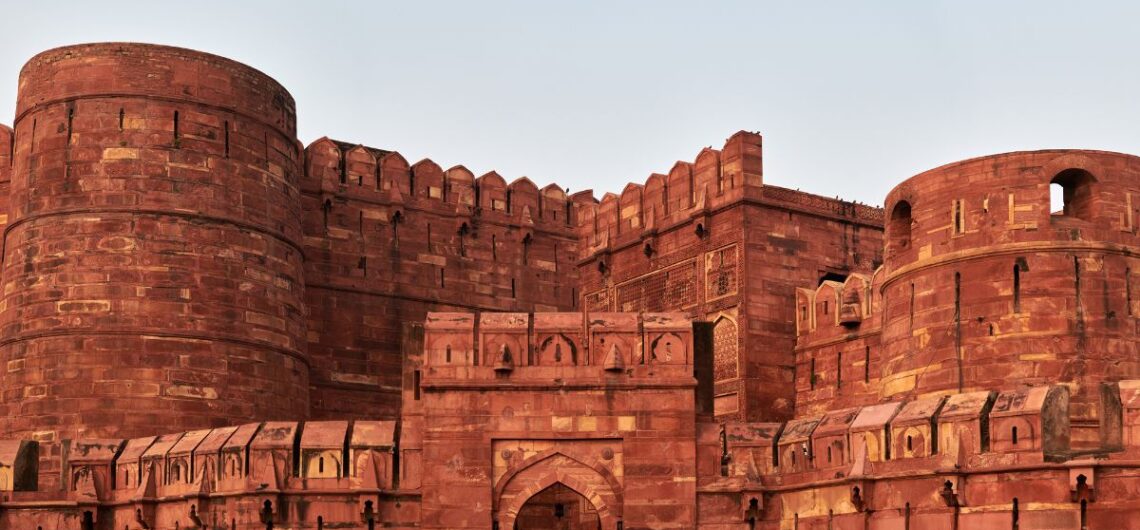
Stretching across 94 acres, enclosed by red sandstone walls that rise 70 feet high, Agra Fort is far more than a military structure — it is a city within a city. Palaces, audience halls, mosques, and gardens accumulated here across three reigns, each emperor leaving a distinct architectural fingerprint.
What gives the fort its emotional depth is the story of Shah Jahan — the man who built the Taj Mahal — who spent his final eight years imprisoned in the fort’s marble tower, gazing at his wife’s tomb across the Yamuna.
Why It Matters: Agra Fort is the historical and architectural anchor of the entire Mughal Golden Age. Visiting it alongside the Taj Mahal does not dilute the experience — it doubles it. The fort explains the Taj; together, they explain the Mughals. If you are planning a trip to Agra, our Agra Travel Guide covers how to fit both into your itinerary.
History of Agra Fort
Agra Fort’s most important chapter began in 1565 when Emperor Akbar ordered its reconstruction in red sandstone. Over the next century, successive emperors — Jahangir and Shah Jahan — added palaces, mosques, and gardens, transforming a military fortress into one of the grandest royal complexes in the Mughal Empire.
A mud fort called Badalgarh existed on this site as early as 1080 CE. It passed through Rajput and Lodi hands before Babur captured Agra after the First Battle of Panipat in 1526 — the moment the legendary Koh-i-Noor diamond is said to have entered Mughal possession.
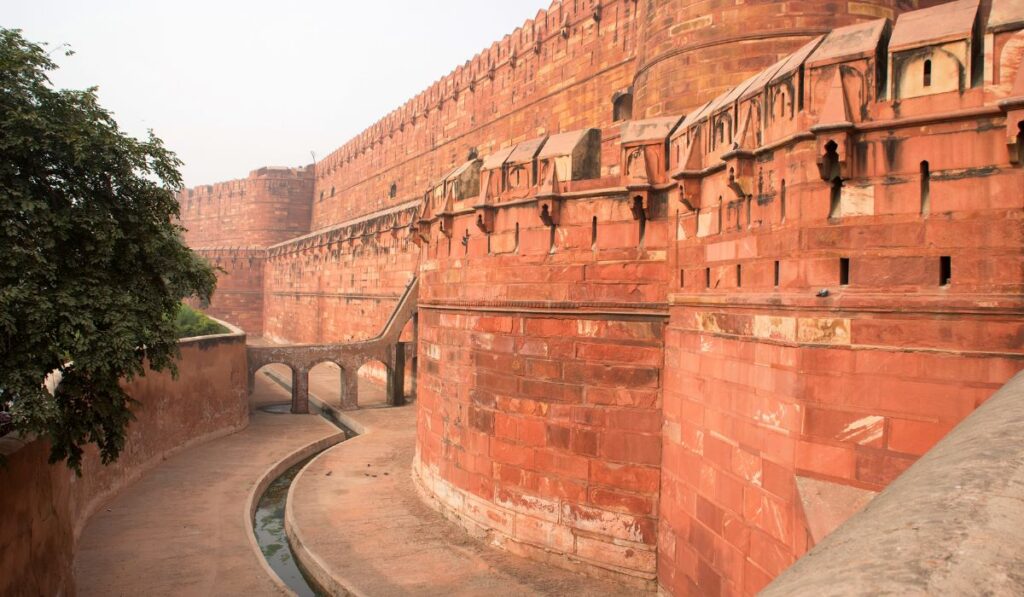
Akbar moved his capital from Delhi to Agra in 1558 and demolished the old fort in 1565, replacing it with a massive red sandstone complex. Over 4,000 craftsmen worked daily for eight years. The result: double ramparts, a 30-foot-wide moat, four gates, and more than 500 internal structures.
Shah Jahan inherited the fort and transformed it. Where Akbar used sandstone, Shah Jahan used white Makrana marble — demolishing many of Akbar’s original buildings to erect the refined pietra dura structures that survive today. In 1638, the capital shifted to Delhi, but Agra Fort remained politically charged. When Aurangzeb deposed his father Shah Jahan in 1658, the Musamman Burj became the emperor’s prison — a marble tower facing the Taj Mahal.
After Mughal decline, the fort passed to the Marathas and then to the British East India Company in 1803. British military occupation caused significant demolitions, but enough survived to make the fort one of the most intact Mughal imperial complexes in India.
Quick Summary: Built by Akbar in 1565, extended by Jahangir and Shah Jahan, and surviving British occupation, Agra Fort encodes three centuries of Mughal history within one set of walls.
Agra Fort Architecture
Agra Fort blends red Rajasthan sandstone with white Makrana marble across structures built by three emperors over nearly a century. It is a UNESCO World Heritage Site recognised for synthesising Persian, Islamic, and Hindu architectural traditions into a single, unified Mughal aesthetic.
The fort’s outer walls — 70 feet high, 2.5 kilometres in circumference — are the first thing visitors notice. Of the original four gates, only the Amar Singh Gate is open to the public. Its deliberate chicanes (sharp turns built into the entrance passage) were designed to break cavalry charges — you feel this defensive logic the moment you walk through.
Akbar-era buildings like the Jahangiri Mahal showcase the synthesis he championed: Hindu stone brackets shaped like elephants, corbelled chhajjas, and ornamental jali screens sit alongside Islamic arches and geometric pattern work. Shah Jahan’s later additions — the Diwan-i-Am, Diwan-i-Khas, Musamman Burj — lean toward Persian-Islamic refinement: cusped arches, delicate pietra dura inlay, and interiors that dissolve into light.
In 1983, UNESCO inscribed Agra Fort as a World Heritage Site for its outstanding universal value as a Mughal architectural masterpiece representing the peak of the empire’s cultural synthesis.
Quick Summary: Agra Fort represents the full arc of Mughal architecture — from Akbar’s robust sandstone fortress aesthetic to Shah Jahan’s refined marble elegance — recognised by UNESCO in 1983.
Top Attractions Inside Agra Fort
Agra Fort contains seven must-see attractions spanning two architectural eras. Akbar’s Jahangiri Mahal is the finest surviving sandstone structure; Shah Jahan contributed the Diwan-i-Am, Diwan-i-Khas, Musamman Burj, Sheesh Mahal, Anguri Bagh, and Moti Masjid.
Jahangiri Mahal
The largest palace inside the fort and the finest example of Akbar-era architecture, Jahangiri Mahal is likely misnamed — most historians believe Akbar built it, with Jahangir later residing here as a prince. Its two-storey structure surrounds a central courtyard where a massive carved stone basin once held rose water for Empress Nur Jahan.
The palace’s façade is where Hindu and Islamic design meet head-on: elephant-bracket columns, tiered jali screens, and chhatri kiosks alongside Islamic arched openings. It is the first major structure you see after entering, and its scale immediately resets your sense of what “Mughal domestic life” meant.
Photography tip: The courtyard in morning light creates deep shadow patterns in the carved stonework — one of the best shots in the fort.
Diwan-i-Am
The Hall of Public Audience is an elegant marble colonnade where the Mughal emperor appeared before his subjects to hear petitions and deliver judgments. Shah Jahan’s raised marble throne alcove — still intact at the hall’s rear — gives a vivid sense of the theatre of imperial power. The long colonnade of marble columns offers excellent linear photography.
Diwan-i-Khas
Adjacent to the Diwan-i-Am, the Hall of Private Audience is where the emperor met senior ministers and foreign ambassadors. Its upper terrace offers sweeping views of the Yamuna River and, on clear days, the Taj Mahal. Shah Jahan’s legendary Peacock Throne reportedly stood here — later looted by the Persian conqueror Nadir Shah in 1739.
Musamman Burj
No structure carries more emotional weight. This octagonal white marble tower, projecting from the fort’s eastern wall over the Yamuna, is where Shah Jahan was imprisoned from 1658 until his death in 1666. It faces the Taj Mahal directly. The pietra dura inlay work here is among the finest in the fort, and the view toward the Taj Mahal — framed through marble jali screens — is the iconic photograph of Agra Fort.
Photography tip: Clearest Taj Mahal views are in winter mornings (October–February). Haze degrades the shot significantly in other seasons.
Sheesh Mahal
Shah Jahan’s royal bathroom is lined with thousands of tiny convex mirror tiles — reportedly imported from Aleppo, Syria. A single candle fractures into thousands of reflected points of light. Even in daylight, the visual effect is extraordinary and represents Mughal decorative arts at their most refined.
Anguri Bagh
The Grape Garden is a formal charbagh — a Mughal garden divided into four quadrants by water channels. It was a private garden for the royal harem and remains geometrically intact. From the terrace above, its symmetry is perfect for photography.
Moti Masjid
The Pearl Mosque is a private mosque built entirely in white marble for Shah Jahan’s personal worship. Three bulbous white domes, an immaculate marble courtyard, and a luminous interior make it one of the most serene spaces in the fort. Note that it is occasionally closed without notice.
Quick Summary: Seven major attractions span the fort’s two architectural eras — the sandstone Jahangiri Mahal from Akbar’s time, and six marble structures commissioned by Shah Jahan. Together they cover statecraft, religion, domestic life, and one of history’s most poignant imprisonments.
Composite Ticket: Foreign nationals can purchase a composite ticket covering the Taj Mahal, Agra Fort, Fatehpur Sikri, and Itimad-ud-Daulah — good value if you plan to visit multiple monuments.
Photography: Still photography is free. Professional video equipment may incur additional fees.
Practical tips:
Book online via the ASI website or the Incredible India portal to skip gate queues.
Keep your ticket — checkpoints inside the fort may ask to see it.
If your visit is part of a Golden Triangle Tour, confirm whether fort entry is included in your package.
Agra Fort Timings
Day
Hours
Saturday to Thursday
6:00 AM – 6:00 PM (last entry 5:30 PM)
Friday
Closed to the general public
Do not visit on a Friday — this is the single most common planning mistake.
An evening Sound and Light Show runs during tourist season in Hindi and English on alternate nights. Confirm current schedules locally.
Best time to arrive: 6:00–8:00 AM. You beat the crowds, get soft light for photography, and cover the main attractions before tour groups arrive. Plan for 2–3 hours minimum; 3–4 hours if you are a history or architecture enthusiast.
How to Reach Agra Fort
By Air
Most international visitors fly into Delhi’s Indira Gandhi International Airport and travel onward. Agra’s Kheria Airport has limited connectivity and is rarely practical for international arrivals.
By Train
Train is the best option from Delhi. The Gatimaan Express (Hazrat Nizamuddin → Agra Cantt) covers the route in ~100 minutes and is the preferred choice for day-trippers. The Shatabdi Express takes around 2 hours. Agra Cantt station is 5 km from the fort — auto-rickshaws and taxis are readily available outside.
By Road
Mode
Journey Time
Notes
Gatimaan Express (train)
~100 minutes
Fastest; book well in advance
Shatabdi Express (train)
~2 hours
Very comfortable
Private car via Yamuna Expressway
3–4 hours
Best for flexibility
Bus (state/private)
4–5 hours
Most economical
Agra is a natural stop on the Delhi–Agra–Jaipur Golden Triangle route. Our Golden Triangle Tour Guide covers how to plan this circuit efficiently.
Best Time to Visit Agra Fort
The best time to visit Agra Fort is October to March, when temperatures are comfortable (10°C–25°C) and the air is clear enough to see the Taj Mahal from the fort’s ramparts. This aligns with the peak tourist season across northern India.
Pleasant, 10–25°C; clear views; peak crowds in Dec–Jan
Summer (Avoid)
April – June
Extreme heat, often above 40°C; very limited shade
Monsoon (Acceptable)
July – September
Relief from heat; lush gardens; rain and poor visibility
Quick Summary: Visit between October and March. Avoid April–June unless you begin before 9:00 AM and carry plenty of water. Late monsoon (August–September) is underrated — fewer crowds, washed air, lower prices.
Agra Fort vs Taj Mahal
Feature
Agra Fort
Taj Mahal
Type
Imperial fort and palace complex
Mausoleum
Built By
Emperor Akbar (primary)
Emperor Shah Jahan
Construction
1565–1573; additions through 1650s
1632–1653
Primary Material
Red sandstone + white marble
White Makrana marble
Size
94 acres
~17 acres
Entry Fee (Foreign)
₹550
₹1,300
Crowds
Moderate
Very heavy
Time Required
2–3 hours
2–3 hours
UNESCO Status
1983
1983
Best For
History, architecture, Mughal context
Iconic photography
Can You See the Other?
Yes — from Musamman Burj
Yes — from gardens
Verdict: Visit the Taj Mahal first (morning light) and Agra Fort after. They are complementary, not competing.
Agra Fort vs Red Fort Delhi
Feature
Agra Fort
Red Fort Delhi
Builder
Emperor Akbar
Emperor Shah Jahan
Built
1565–1573
1638–1648
Size
94 acres
~124 acres
Intact Structures
Several original palaces preserved
Many demolished during British rule
UNESCO Status
1983
2007
Best For
Mughal interior architecture
Scale; Indian Independence history
Verdict: Agra Fort offers a richer architectural experience with more intact Mughal interiors. Red Fort Delhi is historically significant for modern India but has fewer original Mughal structures surviving.
Agra Fort vs Fatehpur Sikri
Feature
Agra Fort
Fatehpur Sikri
Location
Agra city
37 km west of Agra
Builder
Emperor Akbar
Emperor Akbar
Purpose
Military fort and palace
Mughal capital city (abandoned 1585)
Atmosphere
Grand, active urban fort
Eerily preserved ghost city
UNESCO Status
1983
1986
Best For
Political and architectural history
Atmospheric day trip
Verdict: These are complementary, not competing. Add Fatehpur Sikri as a half-day excursion from Agra — our Fatehpur Sikri Travel Guide has everything you need to plan it.
Interesting Facts About Agra Fort
500 buildings, mostly gone. Akbar built over 500 internal structures. Shah Jahan demolished most to build in marble — which is why Akbar-era buildings are rare inside today.
Four gates, one open. Delhi Gate, Lahore Gate, Watergate, and Amar Singh Gate were the originals. Only Amar Singh Gate admits visitors today.
The Koh-i-Noor was here. After Babur’s 1526 conquest, the legendary diamond came into Mughal custody at this fort.
Shah Jahan watched the Taj from prison. Imprisoned in the Musamman Burj from 1658, he could see the Taj Mahal — the tomb he built for his wife — until he died in 1666.
The walls were never breached. Despite multiple sieges and several changes of power, the outer ramparts were never broken through militarily.
4,000 craftsmen, eight years. Akbar’s chronicler Abul Fazl recorded this daily workforce figure during construction.
Sheesh Mahal mirrors came from Syria. The convex mirror tiles are believed to have been imported from Aleppo — an extraordinary 17th-century supply chain.
The moat had crocodiles. Historical accounts suggest the 30-foot-wide moat was stocked with crocodiles as a deterrent.
Travel Tips for Visiting Agra Fort
Arrive at 6:00 AM. The fort opens then and the first two hours are dramatically quieter than the rest of the day. Tour groups typically arrive from 9:00 AM onward.
Hire an ASI-licensed guide. The fort is dense with history that is easy to miss. An official guide costs ₹500–1,000 for a 2-hour tour. Avoid unofficial guides who approach outside the gate.
Wear closed, grip-sole shoes. The stone surfaces are uneven and can be slippery, especially near water features. Sandals and formal footwear are a mistake.
Dress modestly. Covered shoulders and knees are expected. Light cotton in neutral colours is ideal.
Carry water. There is limited shade across much of the fort and no water stalls inside. Bring at least a litre per person, more in summer.
Common mistakes to avoid:
Planning a Friday visit — the fort is closed
Booking only 90 minutes — it is not enough
Trusting unofficial guides at the gate
Bringing oversized bags (mandatory bag check at entry)
Best Photography Spots Inside Agra Fort
1. Jahangiri Mahal Courtyard — Morning light creates dramatic shadow patterns in the carved stone columns. The best architectural photography in the fort.
2. Amar Singh Gate — Photograph looking back outward from inside the gate for a dramatic framing tunnel shot.
3. Musamman Burj — The Taj Mahal framed through marble jali screens. Go early morning or in winter for maximum clarity.
4. Diwan-i-Am colonnade — Position at one end of the marble column row and use linear perspective to compress the depth.
5. Sheesh Mahal interior — The mirror tiles require good light and a steady hand. Check current tripod regulations.
6. Anguri Bagh terrace — Looking down from above reveals the charbagh’s perfect geometric symmetry.
7. Eastern ramparts — Wide-angle views combining the Yamuna River, Agra skyline, and the Taj Mahal on clear days.
Nearby Attractions
Taj Mahal
Located 2.5 km southeast of Agra Fort, the Taj Mahal is the natural companion visit. Built by Shah Jahan between 1632 and 1653 as a mausoleum for Empress Mumtaz Mahal, it is a UNESCO World Heritage Site and one of the Seven Wonders of the Modern World. Entry for foreign nationals is ₹1,300. Book tickets in advance during October–March.
Mehtab Bagh
Directly across the Yamuna from the Taj Mahal, Mehtab Bagh (Moonlight Garden) offers sunset views of the monument without the crowds. A 15-minute drive from Agra Fort and far less visited than the main complex.
Itimad-ud-Daulah
Often called the “Baby Taj,” this is the tomb of Empress Nur Jahan’s grandfather. The first Mughal structure built entirely in white marble with pietra dura inlay, it effectively prototyped the Taj Mahal’s techniques. Less crowded, beautiful in late afternoon light.
Fatehpur Sikri
Akbar’s abandoned capital, 37 km west of Agra, is a UNESCO World Heritage Site frozen in 1585. The Buland Darwaza gateway, Jama Masjid, and extensive palace complex are all built in red sandstone. An excellent half-day excursion.
Frequently Asked Questions About Agra Fort
1. What is Agra Fort?
Agra Fort is a 16th-century Mughal fortress and UNESCO World Heritage Site in Agra, India. Built primarily by Emperor Akbar between 1565 and 1573, it spans 94 acres along the Yamuna River and served as the seat of Mughal imperial power until 1638. It contains palaces, audience halls, mosques, and gardens built across three imperial reigns.
2. Who built Agra Fort?
Emperor Akbar built Agra Fort’s main structure starting in 1565, replacing an earlier mud fort. Jahangir and Shah Jahan added significant structures, with Shah Jahan introducing white marble and the fort’s most ornate interiors. The fort as it exists today reflects all three reigns.
3. Why is Agra Fort famous?
Agra Fort is famous for its Mughal architecture, its role as the centre of imperial power, its direct view of the Taj Mahal, and the story of Shah Jahan — who was imprisoned in the Musamman Burj and reportedly spent his final years gazing at the Taj Mahal.
4. Is Agra Fort a UNESCO World Heritage Site?
Yes. Agra Fort was inscribed in 1983 for its outstanding Mughal architecture and historical significance as the centre of Mughal imperial power.
5. Can you see the Taj Mahal from Agra Fort?
Yes — the Taj Mahal is visible from the Musamman Burj and the eastern ramparts, approximately 2.5 km away. The view is clearest in winter mornings (October–February) when atmospheric haze is minimal.
6. How much time do you need to visit Agra Fort?
Plan 2–3 hours minimum for a comfortable visit covering all main attractions. Allow 3–4 hours if you are deeply interested in history or architecture.
7. Is Agra Fort worth visiting?
Yes — for all Agra Fort offers more historical depth than the Taj Mahal, at less than half the entry fee, with significantly fewer crowds. Many experienced India travellers rate it as equally rewarding.
8. What are the entry fees for Agra Fort?
As of 2025–2026: ₹40 for Indian nationals, ₹550 for foreign nationals, free for children under 15. Confirm current rates on the ASI website before visiting, as fees are subject to revision.
9. What are the timings of Agra Fort?
Open 6:00 AM to 6:00 PM, Saturday through Thursday. Last entry at 5:30 PM. Closed Fridays.
10. What is the best time to visit Agra Fort?
October to March. Temperatures are comfortable (10–25°C) and atmospheric visibility is best for Taj Mahal views. Summer (April–June) is extremely hot. Monsoon (July–September) is atmospheric but wet.
11. How do I get from Delhi to Agra Fort?
The Gatimaan Express from Delhi Hazrat Nizamuddin reaches Agra Cantt in ~100 minutes — the best option. By private car via the Yamuna Expressway takes 3–4 hours. Book train tickets well in advance during peak season.
12. What are the best things to see inside Agra Fort?
Jahangiri Mahal (Akbar-era palace), Diwan-i-Am (Hall of Public Audience), Diwan-i-Khas (Hall of Private Audience), Musamman Burj (Shah Jahan’s prison with Taj Mahal views), Sheesh Mahal (Palace of Mirrors), Anguri Bagh (formal garden), and Moti Masjid (Pearl Mosque).
13. Is Agra Fort bigger than Red Fort Delhi?
Red Fort Delhi is slightly larger (~124 acres vs 94 acres), but Agra Fort has significantly more intact original Mughal structures. Both are UNESCO World Heritage Sites.
14. What is the Musamman Burj
? An octagonal white marble tower on Agra Fort’s eastern wall where Shah Jahan was imprisoned from 1658 until his death in 1666. It faces the Taj Mahal directly and features some of the fort’s finest pietra dura inlay work.
15. What is the Jahangiri Mahal?
The largest palace in Agra Fort and the finest surviving Akbar-era structure. Despite its name, historians believe Akbar built it. It is notable for synthesising Hindu architectural elements (elephant brackets, jali screens, chhatris) with Islamic arched openings — the first major structure visitors see after entering.
Key Takeaways
Agra Fort is a 94-acre Mughal fortress in Agra built by Emperor Akbar between 1565 and 1573.
It is a UNESCO World Heritage Site, inscribed in 1983.
Seven major attractions are open to visitors: Jahangiri Mahal, Diwan-i-Am, Diwan-i-Khas, Musamman Burj, Sheesh Mahal, Anguri Bagh, and Moti Masjid.
Entry fees: ₹40 (Indian), ₹550 (Foreign); children under 15 free.
Timings: 6:00 AM – 6:00 PM, closed Fridays.
Best time to visit: October to March.
Plan 2–3 hours minimum; arrive at 6:00 AM to beat crowds.
The Taj Mahal is visible from the Musamman Burj — clearest in winter mornings.
Combine with the Taj Mahal the same day (Taj first, then fort).
Conclusion
Agra Fort is not a supporting act to the Taj Mahal. It is a monument of equal stature and greater historical depth — a place where imperial ambition, architectural genius, political betrayal, and human tragedy are written in sandstone and marble across 94 acres.
The Taj Mahal will always be the image people carry home from Agra. But Agra Fort is where they begin to understand the world that made it.
Plan your visit between October and March. Arrive at dawn. Walk slowly through the Jahangiri Mahal. Stand quietly at the Musamman Burj and look toward the Taj Mahal — and remember that the man who built that monument stood in exactly this spot, no longer as an emperor, but as a prisoner.
That is the story of Agra Fort. It is worth every hour you give it.



Comments