
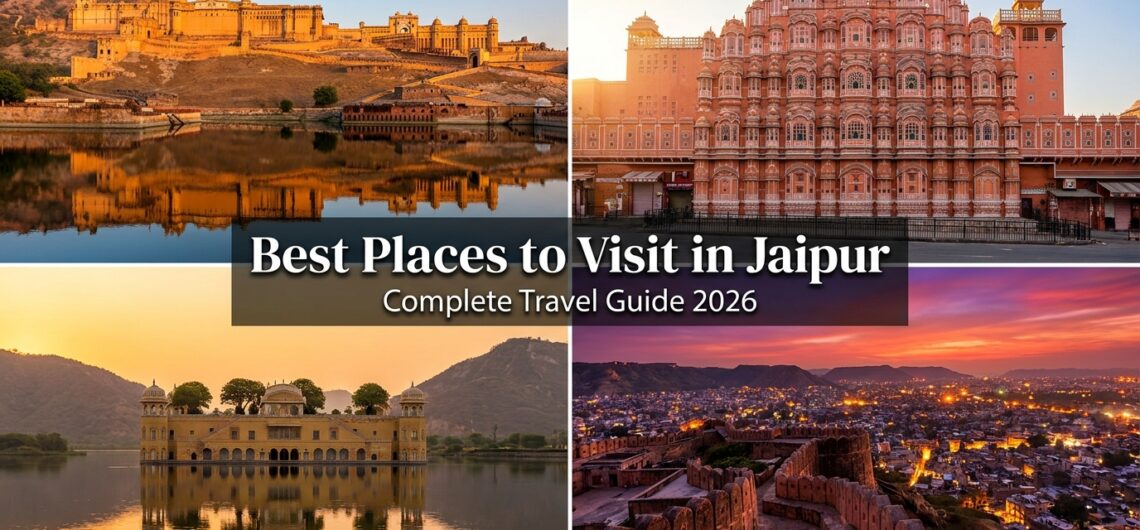
Jaipur is not just a stop on your India trip. It’s the kind of place that stays with you long after you’ve left.
Pink-hued walls, forts on hilltops, bazaars that smell like spices and rosewater, and a royal history you can still feel in the air. It’s easy to see why Jaipur is one of India’s most visited cities.
This guide covers the best places to visit in Jaipur, when to go, what to eat, where to shop, and how to plan a smooth 2-day trip. Whether you’re a first-time visitor, a couple on a romantic getaway, or a family planning a India holiday, you’ll find practical, honest advice here.
Quick Travel Facts
| Detail | Information |
|---|---|
| Location | Northern India |
| State | Rajasthan |
| Best Time to Visit | October to March |
| Ideal Trip Duration | 2 to 3 days |
| Nearest Airport | Jaipur International Airport (JAI) |
| Nearest Railway Station | Jaipur Junction |
| Famous For | Forts, palaces, jewelry, textiles, Rajasthani cuisine |
| UNESCO Status | Jaipur City (Pink City) and Jantar Mantar are UNESCO World Heritage Sites |
Planning a Jaipur trip? Get expert sightseeing recommendations and personalized tour assistance on WhatsApp.
💬 Plan Your Jaipur TripWhy Visit Jaipur?
Jaipur earned its nickname “Pink City” in 1876, when the entire old town was painted terracotta pink to welcome the Prince of Wales. That color scheme has stuck around ever since, and it gives the old city a warm, unified look you won’t find anywhere else in India.
But there’s more to Jaipur than its color.
History and architecture. Jaipur was founded in 1727 by Maharaja Sawai Jai Singh II, a ruler who was also a serious astronomer. His forts, palaces, and observatories still stand today, and most are in excellent condition.
Culture. Jaipur sits at the heart of Rajasthani culture. You’ll see traditional puppet shows, folk music performances, and colorful turbans and lehengas worn as everyday clothing, not just for tourists.
Food. Rajasthani cuisine is rich, spicy, and built to survive desert heat. Think dal baati churma, ghevar, and kachori that will change how you think about street food.
Shopping. Jaipur is famous for block-printed textiles, blue pottery, gemstones, and hand-crafted jewelry. Many of India’s biggest textile and jewelry export businesses started right here.
Festivals. If your dates line up with Teej, Gangaur, or the Jaipur Literature Festival, you’re in for a treat. These events bring the whole city out into the streets.
Luxury experiences. Jaipur is also home to some of the world’s most celebrated heritage hotels, several of them former royal palaces, offering a level of luxury that’s hard to find elsewhere.
If you’re visiting Jaipur for the first time, give yourself at least two full days. Trying to squeeze it into a rushed day trip means you’ll spend more time in traffic than actually seeing the city.
Best Time to Visit Jaipur
Picking the right season makes a real difference in how much you enjoy your Jaipur sightseeing.
Winter (October to March)
This is the best time to visit Jaipur for most travelers. Days are pleasant, usually between 10°C and 25°C, and evenings are cool enough for a light jacket.
Pros: Comfortable weather for walking around forts and markets, clear skies for photography, and festival season overlaps with this window.
Cons: This is peak tourist season, so expect higher hotel prices and bigger crowds at popular spots like Amber Fort.
Summer (April to June)
Summer in Jaipur is intense, with temperatures often crossing 40°C.
Pros: Fewer tourists, lower hotel rates, and shorter queues at monuments.
Cons: Midday heat makes outdoor sightseeing genuinely uncomfortable. You’ll need to plan around early mornings and evenings.
Monsoon (July to September)
Rainfall is moderate in Jaipur compared to other parts of India, but it does cool things down.
Pros: Lush green surroundings, especially near lakes and gardens, and noticeably lower prices.
Cons: Occasional heavy showers can disrupt outdoor plans, and humidity can be uncomfortable.
If your trip is part of a longer North India route, many travelers combine Jaipur with a Delhi travel guide itinerary, since both cities share a similar climate pattern.
Jaipur Attractions at a Glance
Here’s a quick comparison to help you prioritize your time.
| Attraction | Best For | Time Needed | Approx. Entry Fee | Best Time to Visit |
|---|---|---|---|---|
| Amber Fort | History and architecture | 2–3 hours | ₹100–200 (Indians), ₹500–550 (foreigners) | Early morning |
| Hawa Mahal | Photography | 45 min–1 hour | ₹50 (Indians), ₹200 (foreigners) | Sunrise |
| City Palace | Royal heritage | 1.5–2 hours | ₹200–300 (Indians), ₹700+ (foreigners) | Mid-morning |
| Jantar Mantar | Science and astronomy | 45 minutes | ₹50 (Indians), ₹200 (foreigners) | Late morning |
| Jal Mahal | Scenic views | 30–45 minutes | Free (exterior view only) | Sunset |
| Nahargarh Fort | Panoramic views | 1.5 hours | ₹50 (Indians), ₹200 (foreigners) | Late afternoon |
| Jaigarh Fort | Military history | 1–1.5 hours | ₹35–85 (Indians), ₹100+ (foreigners) | Morning |
| Albert Hall Museum | Art and artifacts | 1 hour | ₹40 (Indians), ₹300 (foreigners) | Evening |
| Patrika Gate | Photography | 20–30 minutes | Free | Early morning |
| Johari Bazaar | Shopping | 1.5–2 hours | Free entry | Early evening |
Entry fees are approximate and subject to change. Check official sources before your visit.
Top 10 Best Places to Visit in Jaipur
1. Amber Fort
Why visit: Amber Fort (also spelled Amer Fort) is Jaipur’s most iconic monument, built from pale yellow and pink sandstone on a hill overlooking Maota Lake.
Construction began in 1592 under Raja Man Singh I and continued for nearly two centuries under later rulers, which is why the fort blends Rajput and Mughal architectural styles so seamlessly. It’s famous today for being one of the best-preserved fort complexes in Rajasthan.
Main highlights: The Sheesh Mahal (Mirror Palace), Diwan-e-Aam, and the fort’s massive ramparts, which echo the Great Wall of China from a distance.
Best time to explore: Early morning, right at opening time, to beat both the crowds and the heat.
Approximate visiting duration: 2 to 3 hours.
Entry fee: Around ₹100–200 for Indian visitors, ₹500–550 for foreign nationals. Combined tickets covering multiple monuments are available and worth it if you’re covering several forts.
Opening hours: Typically 8 AM to 5:30 PM.
Walking difficulty: Moderate. There are uphill sections and stairs, so comfortable shoes matter.
Suitable for children and seniors: Yes, though an elephant or jeep ride up the hill is a good option for anyone who prefers not to walk the incline.
Insider tip: Locals usually recommend booking your ticket online in advance during winter months, when queues can stretch well past 30 minutes.
Nearby attraction: Jaigarh Fort and Panna Meena ka Kund are both a short drive away.
Best photo spot: The reflection of the fort in Maota Lake, best captured from the road leading up to the entrance.
Photography tip: Shoot the Sheesh Mahal with a single light source, like a phone flashlight, to see the mirrors sparkle the way they were designed to.
2. Hawa Mahal
Why visit: This five-story palace of pink sandstone, with its honeycomb of 953 small windows, is Jaipur’s most photographed landmark.
Built in 1799 by Maharaja Sawai Pratap Singh, Hawa Mahal was designed so that royal women could observe everyday street life through the latticed windows without being seen themselves. That clever bit of architecture is exactly why it’s famous today.
Main highlights: The intricate latticework windows and the honeycomb-style facade that gives the palace its “Palace of Winds” name, since the design also allows cool air to circulate through the building.
Best time to explore: Sunrise, when the morning light hits the facade and turns it a deep pink-orange.
Approximate visiting duration: 45 minutes to 1 hour.
Entry fee: Around ₹50 for Indian visitors, ₹200 for foreign nationals.
Opening hours: Typically 9 AM to 4:30 PM.
Walking difficulty: Easy, with a few flights of stairs inside.
Suitable for children and seniors: Yes.
Insider tip: One mistake many travelers make is only viewing Hawa Mahal from the street. Step inside, the view looking out through the windows is just as interesting as the view looking in.
Nearby attraction: City Palace and Jantar Mantar are both within walking distance.
Best photo spot: The rooftop cafes directly opposite the palace.
Photography tip: Cross the street to the rooftop cafes opposite Hawa Mahal for the classic full-facade shot.
3. City Palace
Why visit: Still partly home to Jaipur’s royal family, City Palace is a working museum of Rajasthani and Mughal architecture.
The palace complex was built starting in 1729, around the same time Jaipur itself was founded, and it has been continuously expanded by different Maharajas ever since. It’s famous for housing one of the best royal costume and textile collections in India.
Main highlights: The Chandra Mahal, Peacock Gate, and an armory with an impressive weapons collection.
Best time to explore: Mid-morning, after the fort crowds thin out at Amber.
Approximate visiting duration: 1.5 to 2 hours.
Entry fee: Around ₹200–300 for Indian visitors, ₹700 and above for foreign nationals, with premium packages available for access to private royal apartments.
Opening hours: Typically 9:30 AM to 5 PM.
Walking difficulty: Easy, mostly flat courtyards.
Suitable for children and seniors: Yes.
Insider tip: From a photography perspective, the four gates representing the seasons (Peacock, Lotus, Green, and Rose) are each worth photographing individually rather than rushing through.
Nearby attraction: Hawa Mahal is a five-minute walk away.
Best photo spot: The Peacock Gate courtyard.
Photography tip: The Peacock Gate courtyard is best photographed in soft afternoon light, when shadows are less harsh.
4. Jantar Mantar
Why visit: This UNESCO World Heritage Site is a working astronomical observatory built by Jai Singh II in the 1730s.
Jai Singh II built five such observatories across India, and Jaipur’s is the largest and best preserved. It’s famous for its scale, precision, and the fact that its instruments still function accurately today.
Main highlights: The Samrat Yantra, the world’s largest stone sundial, accurate to within two seconds.
Best time to explore: Late morning, when the sun is high enough to read the sundials clearly.
Approximate visiting duration: 45 minutes.
Entry fee: Around ₹50 for Indian visitors, ₹200 for foreign nationals.
Opening hours: Typically 9 AM to 4:30 PM.
Walking difficulty: Easy, flat open grounds.
Suitable for children and seniors: Yes, and it’s a genuinely interesting stop for curious kids.
Insider tip: Hire a guide here if nowhere else on your trip. The instruments are not self-explanatory, and a good guide turns this from “interesting stone shapes” into one of the most fascinating stops in Jaipur.
Nearby attraction: City Palace, right next door.
Best photo spot: Standing at the base of the Samrat Yantra looking up.
Photography tip: Use a wide-angle lens to capture the geometric shapes of the instruments against the sky.
5. Jal Mahal
Why visit: This “Water Palace” appears to float in the middle of Man Sagar Lake, with only its top floor visible above the waterline.
Built in the 18th century, four of its five floors remain submerged when the lake is full. It’s famous for this optical illusion and for being one of the most peaceful, uncrowded views in the city.
Main highlights: The palace itself isn’t open to visitors, but the lakeside view is one of Jaipur’s most peaceful spots.
Best time to explore: Sunset, when the sky reflects off the lake surface.
Approximate visiting duration: 30 to 45 minutes.
Entry fee: Free to view from the lakeside.
Opening hours: Accessible anytime from the road, though the palace interior is closed to the public.
Walking difficulty: Easy.
Suitable for children and seniors: Yes.
Insider tip: This is the best sunset viewpoint in the city that doesn’t require an entry ticket or a climb.
Nearby attraction: Nahargarh Fort, a short drive up the hill.
Best photo spot: The lakeside promenade directly across from the palace.
Photography tip: Walk along the lakeside road for reflection shots with minimal crowd interference.
6. Nahargarh Fort
Why visit: Perched on the Aravalli hills, Nahargarh offers the best panoramic views of Jaipur city.
Built in 1734 and later expanded, the fort was originally designed as a defensive retreat rather than a residence. It’s famous today less for its history and more for being the single best sunset viewpoint over Jaipur.
Main highlights: The fort’s terraces, the Madhavendra Bhawan with its symmetrical apartments, and a small on-site restaurant.
Best time to explore: Late afternoon into sunset.
Approximate visiting duration: 1.5 hours.
Entry fee: Around ₹50 for Indian visitors, ₹200 for foreign nationals.
Opening hours: Typically 10 AM to 5:30 PM.
Walking difficulty: Moderate, uphill approach.
Suitable for children and seniors: Suitable for most, though the uphill drive or climb can be tiring for those with mobility concerns.
Insider tip: Best time to avoid crowds here is a weekday sunset visit. Weekend evenings get busy with local visitors as well as tourists.
Nearby attraction: Jaigarh Fort, connected by a walkable fortified passage.
Best photo spot: The terrace overlooking the entire Pink City.
Photography tip: Arrive an hour before sunset to get both daylight and golden-hour shots of the city below.
7. Jaigarh Fort
Why visit: Built to protect Amber Fort, Jaigarh houses Jaivana, the world’s largest cannon on wheels.
Constructed in 1726, the fort was never captured in battle, which is part of why it’s remained so well preserved. It’s famous for Jaivana, which was fired only once, as a test shot.
Main highlights: The cannon, underground water storage tanks, and sweeping valley views.
Best time to explore: Morning, combined with your Amber Fort visit since they’re close together.
Approximate visiting duration: 1 to 1.5 hours.
Entry fee: Around ₹35–85 for Indian visitors, ₹100 and above for foreign nationals.
Opening hours: Typically 9 AM to 4:30 PM.
Walking difficulty: Moderate, with some uneven terrain.
Suitable for children and seniors: Yes, with some caution on uneven sections.
Insider tip: Locals usually recommend pairing this with Amber Fort in a single morning to save on travel time, since a connecting road links both.
Nearby attraction: Amber Fort, a short drive away.
Best photo spot: The cannon platform with the valley in the background.
Photography tip: Get a low-angle shot of the cannon to emphasize its scale.
8. Albert Hall Museum
Why visit: Jaipur’s oldest museum, housed in an elegant Indo-Saracenic building inside Ram Niwas Garden.
Designed by Sir Samuel Swinton Jacob and opened in 1887, the building itself is considered a landmark of Indo-Saracenic architecture, blending British and Rajasthani design elements. It’s famous for its Egyptian mummy, one of the few on public display in India.
Main highlights: Miniature paintings, metal artifacts, and an Egyptian mummy that’s been on display since 1887.
Best time to explore: Evening, when the building is lit up in gold.
Approximate visiting duration: 1 hour.
Entry fee: Around ₹40 for Indian visitors, ₹300 for foreign nationals.
Opening hours: Typically 9 AM to 5 PM, with the illuminated exterior visible after dark.
Walking difficulty: Easy.
Suitable for children and seniors: Yes.
Insider tip: You don’t need a ticket to enjoy the best part. The illuminated exterior at night, viewed from Ram Niwas Garden, is free and arguably more memorable than the museum interior.
Nearby attraction: Ram Niwas Garden surrounds the museum itself.
Best photo spot: The garden lawn facing the illuminated facade.
Photography tip: The building’s illuminated facade after dark is one of the easiest great shots you’ll get in Jaipur.
9. Patrika Gate
Why visit: One of Jaipur’s newer landmarks, this vividly painted gate has become a favorite for Instagram-style photos.
Built in 2016 as an entrance to Jawahar Circle Garden, it’s far younger than Jaipur’s other attractions. It’s famous purely for its design, nine ornately painted arches representing different aspects of Rajasthani heritage.
Main highlights: Nine arches, each decorated with different Rajasthani motifs and colors.
Best time to explore: Early morning, when it’s quiet and the light is soft.
Approximate visiting duration: 20 to 30 minutes.
Entry fee: Free.
Opening hours: Accessible through the day, though Jawahar Circle Garden has its own timings.
Walking difficulty: Easy.
Suitable for children and seniors: Yes.
Insider tip: This spot gets crowded with local photographers and pre-wedding shoots by mid-morning, so arrive early if you want it to yourself.
Nearby attraction: Jawahar Circle Garden itself, one of Asia’s largest circular parks.
Best photo spot: Center of the gate for the full symmetrical view.
Photography tip: Stand at the center for a symmetrical shot that captures all nine arches at once.
10. Johari Bazaar
Why visit: This is Jaipur’s most famous jewelry and textile market, and a real Jaipur shopping guide essential.
The market has operated as Jaipur’s primary jewelry trading hub since the city’s founding in the 18th century, and many of the same family businesses still run shops here today. It’s famous for Kundan and Meenakari jewelry techniques that originated in Rajasthan.
Main highlights: Kundan and Meenakari jewelry, gemstones, and traditional Rajasthani textiles.
Best time to explore: Early evening, when the market is lively but not overcrowded.
Approximate visiting duration: 1.5 to 2 hours.
Entry fee: Free entry, though budget for shopping.
Opening hours: Typically 10:30 AM to 8 PM, closed on Sundays for some shops.
Walking difficulty: Easy, though crowded lanes.
Suitable for children and seniors: Yes, though crowds can make strollers or wheelchairs tricky.
Insider tip: Best market for souvenirs on a budget is actually Bapu Bazaar nearby, while Johari Bazaar is better suited for genuine gemstone and jewelry purchases.
Nearby attraction: Hawa Mahal and City Palace are both within walking distance.
Best photo spot: The market entrance at dusk, when shop lights start to come on.
Photography tip: Ask before photographing individual shopkeepers or their stalls, most are happy to say yes if asked politely.
Hidden Gems of Jaipur
If you’ve got extra time, these hidden places in Jaipur are worth the detour.
Panna Meena ka Kund. A stunning stepwell near Amber Fort with symmetrical staircases on all four sides. Locals love it because it offers the kind of dramatic geometric photo you’d otherwise associate with much more famous stepwells elsewhere in India. Best visited in the morning for soft light on the stone steps. Photography tip: shoot from the top corner to capture the full symmetry of the staircases. Nearby attraction: Amber Fort, just a few minutes away.
Gaitore Ki Chhatriyan. The royal cremation grounds of Jaipur’s Maharajas, filled with intricately carved marble cenotaphs. It’s a favorite with locals who appreciate its calm, uncrowded atmosphere compared to the city’s busier monuments. Best visited in late afternoon, when the marble carvings catch the light well. Photography tip: focus on the ceiling carvings inside each chhatri, they’re often more detailed than the exteriors. Nearby attraction: Jal Mahal, a short drive away.
Kanak Vrindavan Garden. A Mughal-style garden on the way to Amber Fort, known for its temple and as a popular Bollywood filming location. Locals often stop here for a peaceful break between fort visits. Best visited in the morning, before the day’s heat sets in. Photography tip: the garden’s fountains and archways frame well against the hills behind them. Nearby attraction: Amber Fort and Jaigarh Fort are both close by.
Sisodia Rani Garden. A multi-tiered garden built for a queen, with fountains, murals, and a quiet, romantic atmosphere. It’s popular with local couples for exactly that reason. Best visited in the late afternoon when the fountains are typically running. Photography tip: the terraced levels look best photographed from the topmost tier looking down. Nearby attraction: Ghat ki Guni scenic route.
Khole Ke Hanuman Ji. A temple tucked into the Aravalli hills, surrounded by langur monkeys and forest trails. Locals visit for the temple, but travelers often come for the forest walk that feels worlds away from the city center. Best visited in the early morning when the temple is less crowded and the air is cooler. Photography tip: the forest canopy path makes for good natural-light shots without needing golden hour. Nearby attraction: Nahargarh Fort, connected by a hill road.
Suggested 2-Day Jaipur Itinerary
Here’s a practical plan for places to visit in Jaipur in 2 days.
Day 1: Forts and Palaces
Start early at Amber Fort, then continue to Jaigarh Fort since they’re close by. Head back into the city for lunch, then visit City Palace and Jantar Mantar in the afternoon. End the day at Hawa Mahal for sunset views from a rooftop cafe.
Day 2: City and Culture
Morning visit to Albert Hall Museum, followed by Patrika Gate. Spend the afternoon shopping at Johari Bazaar and Bapu Bazaar. Wrap up the evening at Nahargarh Fort for sunset over the city.
If you have a third day, or you’re combining Jaipur with a wider trip, consider a Golden Triangle Tour Packages route that links Delhi, Agra, and Jaipur into one seamless journey.
What to Eat & Where to Shop
Must-try dishes: Dal Baati Churma, Laal Maas (for non-vegetarians), Ghevar, Pyaaz Kachori, and Lassi from one of the old city’s famous stalls.
Where to eat: Rawat Mishthan Bhandar for kachoris, and any of the rooftop restaurants near Hawa Mahal for a view with your meal. For authentic Rajasthani thalis, the old city’s local eateries usually beat hotel restaurants on both flavor and price.
Where to shop: Johari Bazaar for jewelry, Bapu Bazaar for textiles and juttis (traditional shoes), and Tripolia Bazaar for lac bangles and blue pottery.
Common Tourist Mistakes to Avoid
Avoid these common mistakes to make your Jaipur trip smoother:
- Visiting major attractions during peak afternoon heat. Plan outdoor sightseeing for early morning or late afternoon, especially between April and June.
- Not booking tickets online. Many monuments now offer online booking, which saves you time standing in line.
- Overpaying in local markets. Bargaining is normal and expected in most bazaars, so don’t accept the first price quoted.
- Ignoring local dress etiquette at religious places. Cover your shoulders and knees when visiting temples.
- Underestimating travel time between attractions. Jaipur’s traffic can be unpredictable, so build in buffer time between stops.
Travel Tips
Local transport: Auto-rickshaws and app-based cabs are the easiest way to get around. For longer days of sightseeing, hiring a car with a driver for the day is often more convenient.
Budget planning: Entry fees for major monuments range from ₹50 to ₹500 for domestic visitors, with higher rates for foreign tourists. Budget extra for a composite ticket if you’re covering multiple forts and palaces.
Safety: Jaipur is generally safe for tourists, including solo female travelers, but standard precautions apply, especially in crowded markets.
Photography etiquette: Always ask before photographing people directly, particularly at religious sites.
Cultural etiquette: Remove your shoes before entering temples, and dress modestly at religious sites.
Seasonal travel advice: If you’re traveling in summer, shift your entire sightseeing schedule earlier. Start forts by 7 AM and save markets and museums for the evening once the heat breaks.
FAQs
1. What are the best places to visit in Jaipur for first-time visitors? Amber Fort, Hawa Mahal, City Palace, and Jantar Mantar are must-visit spots that cover Jaipur’s history and architecture in a compact area.
2. How many days do I need in Jaipur? Two days is enough to cover the major attractions, though three days lets you add hidden gems and a more relaxed shopping trip.
3. What is the best time to visit Jaipur? October to March offers the most comfortable weather for sightseeing.
4. Is Jaipur safe for solo travelers? Yes, Jaipur is generally considered safe, though it’s wise to take standard precautions in crowded areas.
5. What is Jaipur famous for? Jaipur is known for its forts and palaces, pink-colored old city, block-printed textiles, and gemstone jewelry.
6. Can I visit Jaipur as a day trip from Delhi? Yes, a same-day Jaipur tour from Delhi is possible, though an overnight stay lets you see far more without rushing.
7. What should I wear when visiting Jaipur’s forts and temples? Comfortable walking shoes for forts, and modest clothing covering shoulders and knees for temples.
8. Is Jaipur part of the Golden Triangle tour? Yes, Jaipur is one of the three cities in India’s classic Golden Triangle, along with Delhi and Agra.
Conclusion
Jaipur rewards travelers who slow down and look closely. Beyond the famous forts and photo spots, there’s a living city of markets, gardens, and quiet corners still waiting to be explored.
If you’re planning a first-time trip to India, Jaipur works beautifully on its own or as part of a bigger journey. Many travelers pair it with Places to Visit in Agra and a Delhi travel guide to complete the classic Golden Triangle circuit, and it’s easy to see why. Each city adds something different, and together they give a fuller picture of North India’s history.
Whatever route you choose, travel at a pace that lets you actually notice things: the smell of fresh kachoris, the sound of temple bells at dusk, the color of sandstone at golden hour. Take your time, respect local customs, and let the Pink City surprise you.
Comments