
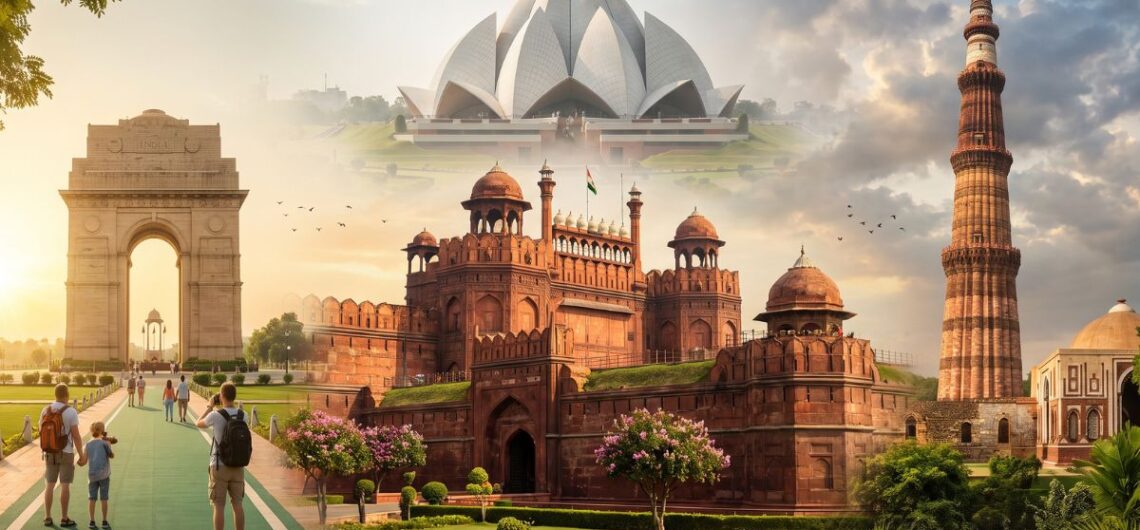
Delhi, India’s sprawling capital, is where more than a thousand years of history collide with the energy of a modern metropolis. Mughal-era forts sit a few kilometers from glass office towers, and centuries-old bazaars hum right alongside metro stations. For most international travelers, Delhi is the first stop on an Indian itinerary, and it rarely disappoints.
The city rewards visitors with grand monuments, quiet gardens, spiritual sites, and some of the country’s best street food, all packed into a walkable, well-connected core. According to Incredible India, the country’s official tourism portal, Delhi alone is home to three UNESCO World Heritage Sites, a rare concentration for a single city.
Whether you have two days or two weeks, Delhi’s mix of history, architecture, culture, and flavor gives every kind of traveler — families, couples, solo explorers — plenty to see. This Delhi travel guide walks through the best places to visit in Delhi, the ideal time to go, and practical tips for getting around the city with ease.
Top 10 Best Places to Visit in Delhi
These are the tourist places in Delhi that consistently top the list for first-time visitors and repeat travelers alike. Together, they cover the city’s Mughal past, colonial history, and modern spiritual landmarks. Here’s a quick-glance summary before the full breakdown below.
| # | Attraction | Known For | Best Time to Visit |
|---|---|---|---|
| 1 | Red Fort | Mughal-era fort, Sound and Light show | Early morning (winter) |
| 2 | Qutub Minar | Tallest brick minaret in the world | Early morning |
| 3 | India Gate | War memorial, evening lights | Early evening |
| 4 | Humayun’s Tomb | Garden-tomb that inspired the Taj Mahal | Mid-morning |
| 5 | Lotus Temple | Lotus-shaped Bahá’í temple | Late afternoon |
| 6 | Swaminarayan Akshardham | Modern temple complex, fountain show | Evening |
| 7 | Jama Masjid | India’s largest mosque | Mid-morning |
| 8 | Chandni Chowk | Historic market and street food | Late morning to evening |
| 9 | Lodhi Garden | Landscaped park with Lodhi-era tombs | Early morning or sunset |
| 10 | Connaught Place | Colonial-era shopping and dining hub | Evening |
Planning to explore the best places to visit in Delhi? Get personalized sightseeing recommendations, trusted local guides, and hassle-free tour assistance on WhatsApp.
💬 Plan Your Delhi Trip1. Red Fort (Lal Qila)
The Red Fort was the seat of Mughal power for nearly 200 years, and its massive red sandstone walls still dominate the Old Delhi skyline. Walking through the Lahori Gate into the fort’s marble pavilions gives a real sense of the scale Mughal emperors built at.
If you’re traveling on a tight budget, sightseeing in Delhi is surprisingly affordable compared to most world capitals — this guide on how to travel India on a small budget breaks down realistic daily costs for the whole trip.
| Best Time to Visit | Practical Tip | Nearby Attraction |
|---|---|---|
| Early morning in winter (Oct–Mar) | Catch the evening Sound and Light show; book tickets slightly ahead in peak season | Chandni Chowk, right across the road |
Avoid This Mistake: Most visitors head straight to the Diwan-i-Khas and skip the Mumtaz Mahal museum wing entirely. It houses genuine Mughal-era artifacts with almost no crowds, and it’s also one of the only shaded, air-conditioned stops inside the fort — worth the short detour before fatigue sets in.
2. Qutub Minar
At over 70 meters, Qutub Minar is the tallest brick minaret in the world, and its carved sandstone and marble surface tells the story of several centuries of construction and repair. The complex around it, dotted with tombs and ruins, is just as interesting as the tower itself.
The site, along with several of Delhi’s other historical places, is protected and maintained by the Archaeological Survey of India, which publishes current visiting hours and conservation updates.
| Best Time to Visit | Practical Tip | Nearby Attraction |
|---|---|---|
| Early morning, soft light and quieter grounds | Wear comfortable shoes — the archaeological park is bigger than it looks from the entrance | Mehrauli Archaeological Park, next door |
Best Photo Spot: Skip the crowded base of the minaret and shoot from near the Alai Darwaza gateway instead. Framing the tower through the gate’s carved sandstone arch cuts out the crowds and, in late afternoon, catches warm light that base-level photos rarely pick up.
3. India Gate
India Gate is a 42-meter war memorial honoring soldiers who died in World War I and the Third Anglo-Afghan War. It anchors one end of Kartavya Path, Delhi’s grand ceremonial avenue, and is one of the most photographed famous places in Delhi.
| Best Time to Visit | Practical Tip | Nearby Attraction |
|---|---|---|
| Early evening, when it’s lit up and lawns fill with families | Bring a light jacket in winter — the open avenue gets breezy | The National War Memorial, a short walk away |
Local Tip: The roasted corn and kulfi carts around India Gate are treated by Delhiites as part of the outing, not just tourist snacks. Arrive by auto-rickshaw rather than cab — drivers know shortcuts around the diplomatic enclave that beat the traffic circles surrounding the monument.
4. Humayun’s Tomb
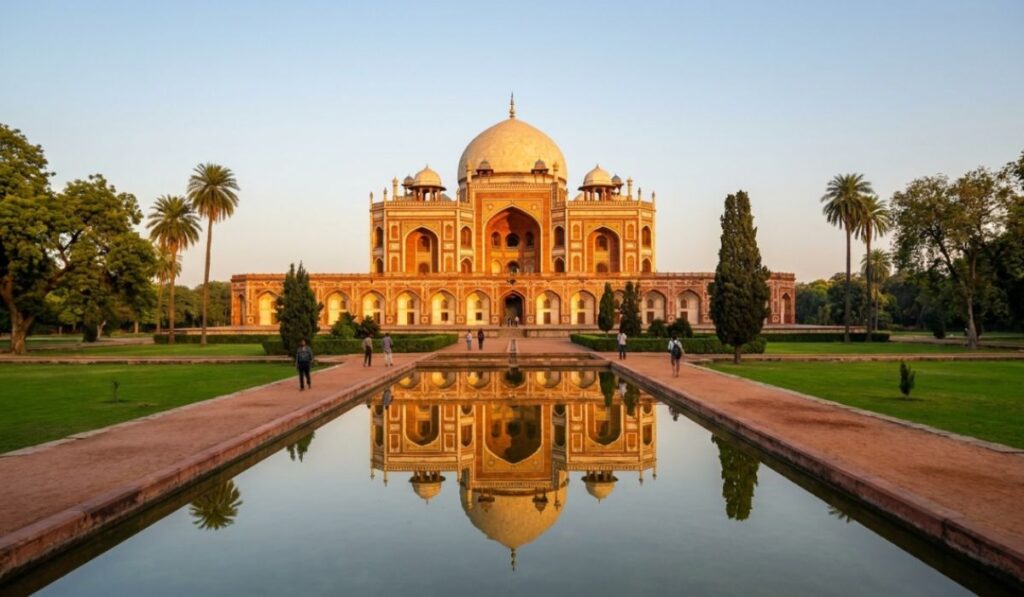
Often called a preview of the Taj Mahal, Humayun’s Tomb was the first grand garden-tomb in India and directly influenced the design that came later in Agra. Its Persian-style charbagh garden and red-and-white sandstone facade make it one of the most elegant historical places in Delhi.
If Mughal architecture like this has caught your interest, many travelers extend their trip with a Golden Triangle Tour India 3 Days, which continues on to the Taj Mahal in Agra and the palaces of Jaipur.
| Best Time to Visit | Practical Tip | Nearby Attraction |
|---|---|---|
| Mid-morning, when sunlight highlights the stonework | Budget at least an hour — the gardens alone are worth the slow walk | Sunder Nursery, next door |
Good to Know: Most tour groups walk straight past Isa Khan’s Tomb, a smaller and older structure just inside the main gate. It’s quieter, less restored, and actually gives useful context on how the garden-tomb design evolved before Humayun’s Tomb itself was built.
5. Lotus Temple
The Lotus Temple is a Bahá’í House of Worship shaped like a blooming lotus flower, built from white marble and open to people of every faith. There’s no preaching or ritual here — just a quiet hall meant for personal reflection, which makes it one of the more unusual things to do in Delhi.
| Best Time to Visit | Practical Tip | Nearby Attraction |
|---|---|---|
| Late afternoon, best light on the marble petals | No photography inside the main hall; shoes must come off before entering | Kalkaji Temple, a short drive away |
Insider Tip: Arrive right at opening time on a weekday. Weekend queues routinely stretch past an hour, but the stillness inside the petals only really registers when the hall isn’t packed — a quality rushed, midday visits almost never capture.
6. Swaminarayan Akshardham
Akshardham is a sprawling modern temple complex known for its intricately carved stone architecture, exhibitions on Indian philosophy, and an evening musical fountain show. It’s one of the more immersive Delhi tourist attractions, closer to a cultural center than a single monument.
| Best Time to Visit | Practical Tip | Nearby Attraction |
|---|---|---|
| Evening, for the water and light show | Security is strict — no bags, phones, or cameras inside; free lockers provided | Yamuna riverfront gardens, along the complex |
Avoid This Mistake: Travelers often schedule Akshardham as a quick stop before another sight, but the boat-ride exhibition and evening fountain show alone run over two hours combined. Treat it as a half-day destination rather than an add-on, or you’ll end up rushing the parts worth seeing most.
7. Jama Masjid
Built by Shah Jahan, the same emperor behind the Red Fort and the Taj Mahal, Jama Masjid is one of India’s largest mosques and still an active place of worship. Climbing the southern minaret rewards visitors with sweeping views over the rooftops of Old Delhi.
| Best Time to Visit | Practical Tip | Nearby Attraction |
|---|---|---|
| Mid-morning, avoiding prayer times and Fridays | Modest dress required (robes available at entrance); small camera fee applies | Red Fort and Chandni Chowk, walking distance |
Why You’ll Love It: The call to prayer echoing across Old Delhi’s rooftops from the minaret is something no photo captures. Sit in the courtyard around dusk and watch the neighborhood’s evening rhythm unfold below — it gives a feel for Old Delhi that the monument checklist alone misses.
8. Chandni Chowk
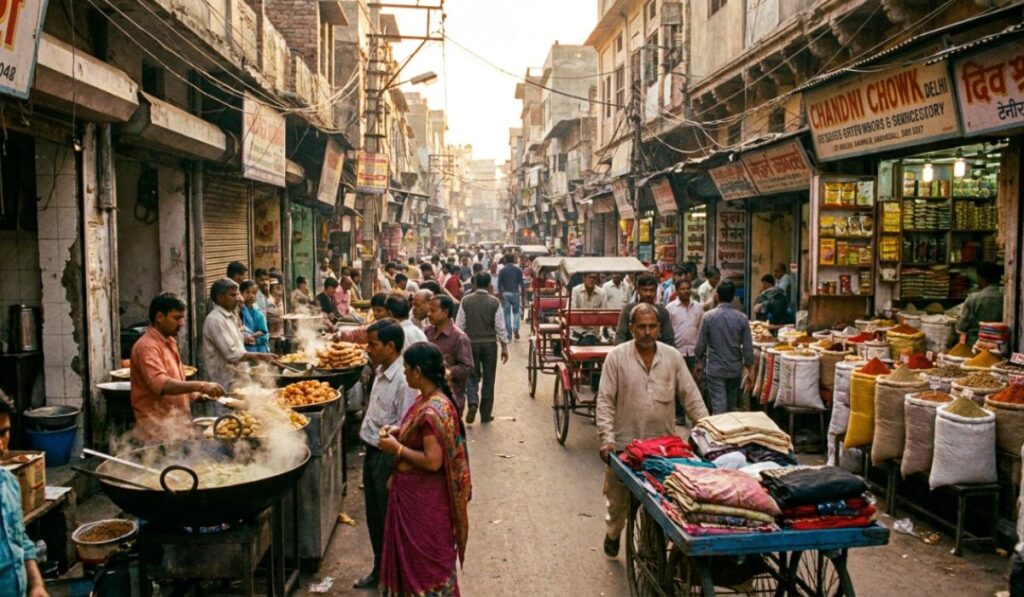
Chandni Chowk is Old Delhi’s 17th-century market, a tangle of narrow lanes packed with spice traders, jewelry shops, and some of the best street food in the country. It’s chaotic in the best way, and it’s the kind of place where a short walk turns into an afternoon.
| Best Time to Visit | Practical Tip | Nearby Attraction |
|---|---|---|
| Late morning to early evening (avoid summer midday heat) | Go hungry — try the parathas at Paranthe Wali Gali and jalebi near the main square; watch your belongings | Jama Masjid and the Red Fort, both bordering the market |
Insider Tip: Duck one street over into Kinari Bazaar, where wedding trims, lace, and embellishments have been sold the same way for generations. It sees a fraction of the foot traffic of the main lane and gives a far more honest sense of how the market actually functions day to day.
9. Lodhi Garden
Lodhi Garden wraps 15th-century tombs of the Lodhi dynasty inside a landscaped city park, and it’s become one of Delhi’s favorite spots for a morning walk or a quiet break from sightseeing. The contrast of manicured lawns against centuries-old domes is unlike anywhere else in the city.
| Best Time to Visit | Practical Tip | Nearby Attraction |
|---|---|---|
| Early morning or just before sunset | Slot it between two heavier sightseeing stops — free entry and shaded paths make an easy reset | Safdarjung Tomb, close by |
Local Tip: Delhi’s morning walking and yoga regulars treat Lodhi Garden as a daily ritual, and a bench-side chat with them often turns up better food or transport advice than a guidebook. Weekday mornings stay quiet; weekends fill quickly with picnicking families by mid-morning.
10. Connaught Place
Connaught Place is Delhi’s colonial-era circular market, built in the 1930s and still one of the city’s main hubs for shopping, dining, and people-watching. Its white Georgian-style colonnades make it easy to spot, and it’s well connected by metro, which makes it a convenient base.
| Best Time to Visit | Practical Tip | Nearby Attraction |
|---|---|---|
| Evening, when the inner circle lights up | Use it as an orientation point — most central Delhi sights are a short metro or auto-rickshaw ride away | Jantar Mantar, around the corner |
Good to Know: The inner and outer circles are laid out almost identically, which trips up first-time visitors trying to navigate by shop names. Look for the block letters marked on the pillars instead — that’s the system locals actually use to orient themselves, not store signage.
Best Time to Visit Delhi
The best time to visit Delhi is between October and March, when daytime temperatures sit comfortably between 15°C and 25°C and skies are mostly clear. This window covers Delhi’s two most pleasant travel seasons.
| Season | Months | Weather | Good For |
|---|---|---|---|
| Winter | December–February | Cool, foggy mornings, cold nights — pack layers | The most popular and comfortable stretch for sightseeing |
| Autumn | October–November | Mild and clear | Fewer crowds, same comfort as winter |
| Spring | February–March | Mild, warming up | Fewer crowds before summer heat sets in |
| Summer | April–June | Intense heat, often above 40°C | Indoor sights and evening activities only |
| Monsoon | July–September | Humid, occasional flooding in low-lying areas | Budget travel, but expect sightseeing disruptions |
Travel Tips for Visiting Delhi
| Category | Recommendation |
|---|---|
| Transportation | Metro, app-based cabs, and auto-rickshaws all work well; use a cab for longer distances rather than negotiating rickshaw fares repeatedly |
| Metro Travel | Fast and air-conditioned, connecting most major tourist places directly; get a rechargeable travel card to skip single-token lines |
| Clothing | Light, breathable fabrics most of the year, plus a warm layer for winter mornings and evenings; cover shoulders and knees at religious sites |
| Safety | Use registered cabs, avoid isolated areas after dark, and keep valuables secured in crowded markets like Chandni Chowk |
| Local Etiquette | Remove shoes before entering temples and mosques, ask before photographing people, and bargain lightly at markets |
| Photography | Early morning light suits open-air sites like the Red Fort; the Lotus Temple and Akshardham photograph better in soft afternoon light — check signage before shooting indoors |
Conclusion
Delhi rewards travelers who give it more than a rushed day trip. Between Mughal forts, colonial markets, quiet gardens, and modern spiritual landmarks, the city covers a range that few capitals can match in one place. Start with the sites in this Delhi travel guide, build in time for a slow walk through Chandni Chowk, and let the city’s layers unfold at their own pace. Delhi has a way of turning a short stopover into the highlight of an entire India trip.
Frequently Asked Questions (FAQs)
What are the best places to visit in Delhi?
The Red Fort, Qutub Minar, India Gate, Humayun’s Tomb, Lotus Temple, Akshardham, Jama Masjid, Chandni Chowk, Lodhi Garden, and Connaught Place are the ten best places to visit in Delhi for first-time travelers.
Which tourist attraction is most famous in Delhi?
The Red Fort is generally considered the most famous place in Delhi, thanks to its scale, Mughal history, and status as a UNESCO World Heritage Site.
Is one day enough to explore Delhi?
One day is enough to see two or three major sights, such as the Red Fort, Chandni Chowk, and India Gate, but it isn’t enough to experience the full city. Two to three days allow a more relaxed pace.
What is the best time to visit Delhi?
The best time to visit Delhi is between October and March, when temperatures are cooler and more comfortable for sightseeing.
Which places in Delhi are free to visit?
India Gate, Lodhi Garden, Jantar Mantar’s exterior, and the Lotus Temple’s grounds are free to visit, though some interior sections or special exhibits may charge a small fee.
Is Delhi safe for tourists?
Delhi is generally safe for tourists who follow standard precautions, such as using registered transport, staying alert in crowded markets, and avoiding isolated areas late at night.
How can tourists travel around Delhi?
The Delhi Metro is the most efficient way to get around, supplemented by app-based cabs and auto-rickshaws for shorter or less-connected routes.
Which places should first-time visitors not miss?
First-time visitors shouldn’t miss the Red Fort, Qutub Minar, India Gate, and Humayun’s Tomb, since these four capture Delhi’s Mughal and colonial history in a single, manageable itinerary.
Comments