

Every year, millions of people fly across oceans and continents — just to stand in front of one building. And the moment they see it, they understand why.
The Taj Mahal is not just a monument. It is a feeling. A white marble dream that seems to glow from within. It is the kind of place that makes you go quiet — and that is saying something for a spot filled with thousands of tourists.
If you are planning a Taj Mahal Tour, this guide covers everything you need to know. History, timings, tips, sunrise magic — all of it, right here.
The Love Story Behind the Taj Mahal
You cannot talk about the Taj Mahal without talking about love. Real, heartbreaking, emperor-level love.
Mughal Emperor Shah Jahan built this monument for his favourite wife, Mumtaz Mahal, who died in 1631 while giving birth to their 14th child. He was so devastated that his hair reportedly turned white overnight.
Construction started in 1632 and took over 20 years to complete. More than 20,000 workers — architects, craftsmen, and labourers — worked tirelessly to bring Shah Jahan’s vision to life.
When it was finally done, he had created something the world had never seen before.
Taj Mahal History fact: Shah Jahan himself was later imprisoned by his own son, Aurangzeb. He spent his final years in the Agra Fort, gazing at the Taj Mahal from a window — unable to visit the tomb of the woman he loved.
That story alone gives you chills.
Stunning Architecture of the Taj Mahal
The Taj Mahal Architecture is a masterpiece of Mughal design. It blends Islamic, Persian, Ottoman Turkish, and Indian styles into one perfect, balanced structure.
Here is what makes it so extraordinary:
- The Main Dome: It stands 73 metres tall. The dome is surrounded by four smaller domes called chhatris.
- The Minarets: Four minarets frame the main tomb. Each one is slightly tilted outward — so that in case of an earthquake, they fall away from the main structure. Genius engineering, even by today’s standards.
- White Makrana Marble: The marble was sourced from Rajasthan. It changes colour through the day — pinkish at dawn, dazzling white at noon, golden at sunset, and silver under moonlight.
- Pietra Dura Inlay Work: Thousands of precious and semi-precious stones — like lapis lazuli, carnelian, and turquoise — are inlaid into the marble in floral patterns. No paint was used anywhere.
- Calligraphy: Verses from the Quran are carved around the arched doorways in black marble, perfectly sized to look uniform from a distance.
The symmetry is almost supernatural. Every element on the left mirrors the right. The garden, the reflecting pool, the mosque, the guesthouse — everything is perfectly balanced.
UNESCO Recognition and Global Importance
In 1983, the Taj Mahal was declared a UNESCO World Heritage Site. It was also named one of the New Seven Wonders of the World in 2007.
But these titles only confirm what people already knew. This is not just India’s treasure — it belongs to all of humanity.
Experts estimate that between 7 and 8 million people visit every year. A large portion of them are foreign tourists from the US, UK, Europe, China, Japan, and Australia.
Why do they come so far? Because no photograph — however beautiful — does it justice. You have to stand there to understand it.
Many travellers combine the Taj Mahal with Delhi and Jaipur on a Golden Triangle Tour India — the most popular India itinerary for international visitors.
Best Time to Visit the Taj Mahal
By Season
The best time to visit is between October and March. The weather is cool and pleasant, making it easy to walk around and enjoy the site.
- October to February: Ideal months. Cool mornings, clear skies, and beautiful light for photos.
- March to May: Hot weather. Not recommended, especially for midday visits.
- June to September: Monsoon season. The Taj Mahal looks stunning in the mist, but the heat and humidity can be uncomfortable.
The Sunrise Experience — The Magic Hour
If there is one thing every travel expert agrees on, it is this: the sunrise visit to the Taj Mahal is unlike anything else in the world.
Imagine arriving before dawn, the air still cool and quiet. Slowly, as the sun rises over the Yamuna river, the Taj Mahal turns from grey to pink to a blazing, luminous gold.
The reflecting pool catches every shade. There are fewer crowds at this hour. You can actually hear the silence.
This is why the Taj Mahal Sunrise Tour Package sells out so fast. Photographers, honeymooners, solo travellers — everyone comes back from a sunrise visit saying it was the best decision they made.
For an even more unforgettable experience, the Moon Light with Sunrise Tour lets you see the Taj Mahal by moonlight AND at sunrise — two completely different magical moments in one trip.
Book early. Spots fill up quickly in peak season.
Taj Mahal Timings and Ticket Information
Opening Hours
The Taj Mahal is open six days a week. It is closed on Fridays (for Friday prayers at the mosque inside the complex).
| Day | Timings |
| Saturday to Thursday | Sunrise to Sunset |
| Friday | Closed |
Moonlight viewing is available on 5 nights per month — the night of the full moon, two nights before, and two nights after. Tickets for moonlight viewing are limited and must be booked in advance.
Taj Mahal Ticket Price (2026)
| Visitor Type | Ticket Price |
| Indian Citizens | ₹50 |
| SAARC/BIMSTEC Nationals | ₹540 |
| Foreign Tourists | ₹1,100 |
| Children under 15 | Free |
Note: Entry to the main mausoleum (inner chamber) requires an additional fee of ₹200. The cenotaphs of Mumtaz Mahal and Shah Jahan are inside — this is worth it.
Booking a guided tour means all entry tickets are handled for you. The Same Day Agra Tour includes skip-the-line entry, hotel pickup, and a licensed guide — starting at just $149.
Things to Do at the Taj Mahal
The Taj Mahal complex is larger than most people expect. Here is how to make the most of your visit:
1. Walk Through the Great Gate (Darwaza-i-Rauza)
Your first full view of the Taj Mahal happens when you walk through this red sandstone gateway. The framed view is iconic. Stop here. Breathe. Take it in slowly.
2. Explore the Charbagh Garden
The formal garden in front of the Taj is divided into four sections by water channels. It represents the Islamic concept of paradise. Walk through it and look back at the Taj from different distances.
3. Visit the Mosque and Guesthouse
On either side of the main tomb sit two identical red sandstone buildings. One is a working mosque. The other (called the Jawab, or “answer”) was built purely for symmetry. Both are beautiful and often overlooked.
4. Taj Mahal Photography Tips
- Best photo spot: The central reflecting pool. The classic “two Taj Mahals” reflection shot is taken here.
- Side angles: Walk to the sides of the garden for different perspectives.
- Avoid midday: The light is harsh and flat. Go at sunrise or late afternoon for warm tones.
- Tripods: Not allowed inside without a permit.
If photography is your main reason for visiting, the Taj Mahal Reels & Royal Frames tour is designed for exactly this — a 2-day photography-focused experience covering every angle and every light condition.
5. Explore the Taj Mahal Museum
Inside the complex, there is a small museum with Mughal artefacts, including architectural drawings and pieces of marble. Entry is free with your main ticket.
6. Also Visit Agra Fort
Just 2.5 km from the Taj Mahal, Agra Fort is where Shah Jahan spent his final years imprisoned — gazing at his masterpiece. It is a deeply moving place when you know the history. Most Taj Mahal Day Tour itineraries include both sites.
Taj Mahal Travel Tips for First-Time Visitors
These are the real-world tips that make your trip smooth and stress-free:
Getting There
- Agra is well-connected by road and rail from Delhi, Jaipur, and other major cities.
- Travelling from Delhi? The Same Day Taj Mahal Tour by Vande Bharat Train from Delhi is a popular and comfortable option — the high-speed train makes the journey fast and scenic.
- Prefer flexibility? A private car tour gives you your own pace. The Same Day Agra Tour by car from Delhi includes hotel pickup and all entry tickets.
- Coming from Jaipur? The Same Day Agra from Jaipur Tour covers the journey perfectly.
- Travelling from South India? Tours are available from Bangalore and Chennai too — the One-Day Taj Mahal Tour from Bangalore by Flight via Delhi makes it easy.
At the Site
- Wear comfortable, light shoes. You will walk quite a bit.
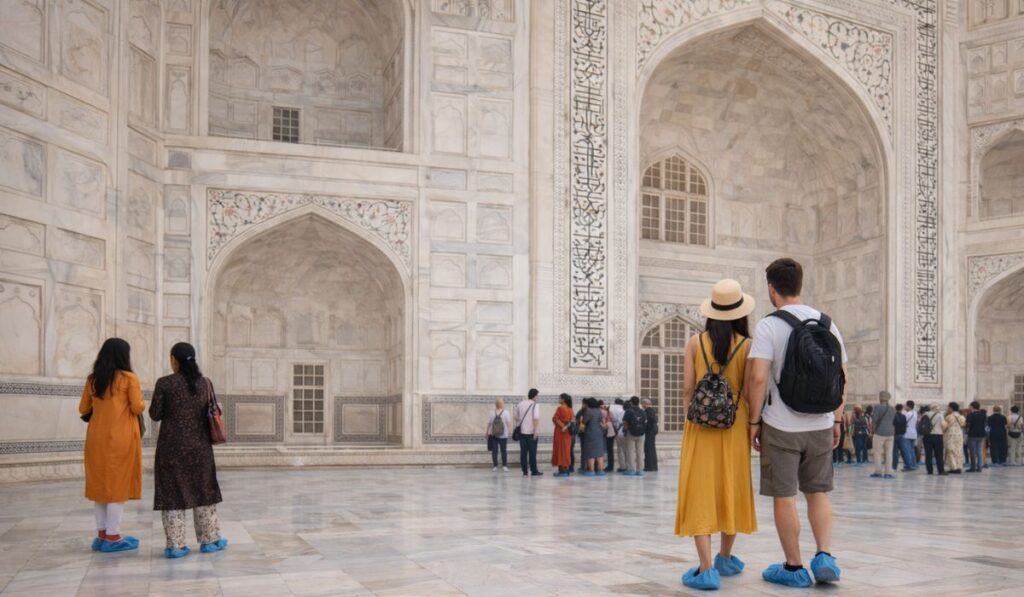
- Overshoes (shoe covers) are provided free at the entrance to the main mausoleum. Socks are a good idea.
- Large bags, food, and tobacco are not allowed inside the complex.
- Carry cash for small purchases and for hiring guides at the gate.
Practical Taj Mahal Facts to Remember
- Photography is free inside the complex but prohibited in the inner chamber.
- Drones and video cameras require special permits.
- Keep your ticket safe — it is checked multiple times.
- The Taj Mahal is closed on Fridays.
Scam Alert
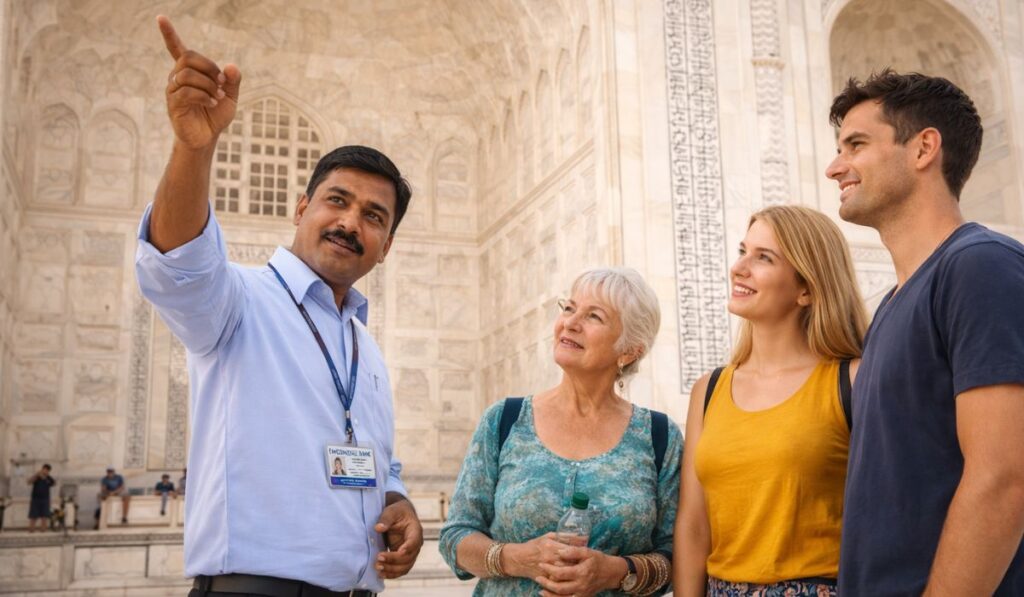
Foreign tourists are often targeted by touts near the entrance area. Book your transport and guided tours in advance through trusted, reviewed providers. All India Travel Bear guides are licensed, reviewed, and regularly praised by name in international traveller reviews.
Special Experiences Worth Considering
For Honeymooners
There is no more romantic destination on Earth than a monument built purely out of love. The Taj Mahal Honeymoon Tour is a beautifully curated 2-day experience designed around the magic of this place — sunrise views, private moments, and memories that last a lifetime.
For Women Travelling Solo or in Groups
Safety and comfort matter. The Women Special Tour Package and the Women’s Golden Triangle Tour are designed specifically for female travellers — with vetted guides, safe accommodation, and a supportive travel environment.
For LGBTQ Travellers
India Travel Bear is proud to offer LGBTQ Tour Packages that are inclusive, pride-affirming, and completely welcoming. Explore the Taj Mahal and the Golden Triangle with full dignity and respect.
For Festival Lovers
Imagine visiting during India’s most colourful festivals. The Golden Triangle Tour with Holi Festival and the Golden Triangle with Diwali Festival add unforgettable cultural experiences to the classic itinerary.
Why the Taj Mahal is a Must-Visit Destination
People visit the Taj Mahal for different reasons. But they all leave feeling the same thing — that they witnessed something truly irreplaceable.
For history lovers, it is a living record of the Mughal Empire at its peak.
For architects and designers, it is a study in perfection — proportion, symmetry, and craftsmanship that has never been equalled.
For photographers, it offers some of the most iconic shots in the world at every hour of the day.
For couples and honeymooners, there is nowhere more romantic on Earth. A monument built purely out of love, for love.
For curious travellers, it is the kind of place that makes you think — about time, about beauty, about what human beings are capable of creating.
If you are exploring the Golden Triangle (Delhi, Agra, Jaipur), a Taj Mahal visit is the undisputed centrepiece. Many travellers say that after seeing the Taj, everything else on their trip felt different.
Browse all available Taj Mahal Tour Packages to find the itinerary that fits your timeline and travel style. Whether you have one day or one week, there is a perfect option waiting.
Conclusion
The Taj Mahal is one of those rare places in the world that actually lives up to its reputation. It does not disappoint. If anything, it surprises you — because it is more beautiful, more emotional, and more powerful than any photo or description can prepare you for.
Whether you go at sunrise, spend a full day exploring the complex, or make it part of a longer India journey, a Taj Mahal Tour will stay with you long after you leave.
There is a reason people cry when they see it for the first time. There is a reason they come back.
Plan ahead, go early, and take your time. The Taj Mahal rewards those who are present with it — fully, quietly, and without rushing.
Frequently Asked Questions
Q1. What is the best time to visit the Taj Mahal?
The best time to visit is between October and March, when the weather is cool and pleasant. Sunrise visits are especially magical — the marble glows pink and gold as the sun rises over the Yamuna river.
Q2. What are the Taj Mahal’s opening hours and which day is it closed?
The Taj Mahal is open Saturday to Thursday, from sunrise to sunset. It remains closed every Friday for prayers at the mosque inside the complex.
Q3. How much does a Taj Mahal ticket cost for foreign tourists?
Foreign tourists pay ₹1,100 for entry. Children under 15 enter free. An additional ₹200 is charged to enter the inner mausoleum chamber, which houses the cenotaphs of Mumtaz Mahal and Shah Jahan.
Q4. Can I visit the Taj Mahal at night or by moonlight?
Yes! Moonlight viewing is available on 5 nights per month — the full moon night plus two nights before and after. Tickets are limited and must be booked well in advance.
Q5. Why was the Taj Mahal built?
Emperor Shah Jahan built the Taj Mahal in memory of his beloved wife Mumtaz Mahal, who died in 1631. Construction began in 1632 and took over 20 years and 20,000 workers to complete.
Q6. What is special about the Taj Mahal’s architecture?
The Taj Mahal blends Islamic, Persian, Ottoman Turkish, and Indian architectural styles. Its marble changes colour throughout the day — pink at dawn, white at noon, golden at sunset, and silver under moonlight. The four minarets are even slightly tilted outward as an earthquake-safety measure.
Q7. Is the Taj Mahal a UNESCO World Heritage Site?
Yes. The Taj Mahal was declared a UNESCO World Heritage Site in 1983 and was also named one of the New Seven Wonders of the World in 2007.
Q8. How do I get to Agra from Delhi to visit the Taj Mahal?
You can travel from Delhi by Vande Bharat high-speed train, private car, or as part of a same-day tour package. Most tours include hotel pickup, transportation, and entry tickets.
Q9. What should I not bring to the Taj Mahal?
Large bags, food, tobacco, and tripods (without a permit) are not allowed inside the complex. Drones and video cameras require special permits. Photography inside the inner chamber is prohibited.
Q10. Is the Taj Mahal worth visiting for just one day?
Absolutely. A well-planned same-day Taj Mahal tour from Delhi or Jaipur gives you enough time to enjoy the site fully — especially if you arrive at sunrise and also visit Agra Fort nearby.
Comments