
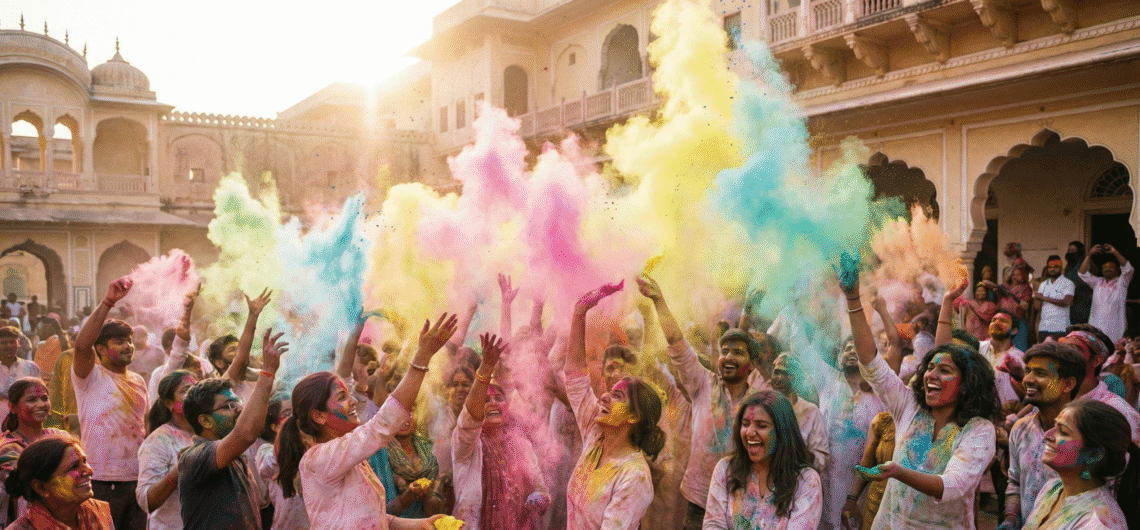
When people picture Holi, they see photos filled with joyful faces, air exploding with colors, and strangers laughing together like best friends. But here’s a more honest, more real version — Holi in India can be magical, and Holi can be messy. It can be the best day of your trip, or the most uncomfortable one. Your experience depends on where you are, who you go with, and how prepared you are.
If you’re flying into Delhi during Holi and planning a flexible, backpacker-style journey across North India — you’ve already chosen one of the most intense, colourful and culturally layered times to explore the country. This article will help you understand how to make the most of it — without feeling overwhelmed, unsafe or rushed.
Understanding Holi Beyond the Photos: What the Festival Actually Represents
Before anything else, it’s important to know what Holi truly symbolizes:
- The arrival of spring
- The victory of good over evil
- The playful romance of Krishna and Radha
- A dissolving of social boundaries
It’s a moment when strangers become friends, caste and class lines blur, and laughter becomes a form of connection. In its ideal form, Holi is celebration, equality, color, music, dance, sweets, and bonding.
But in real-world street environments — especially in crowded cities — Holi can also turn into:
- unsolicited touching
- chemical colors
- reckless behaviour
- lack of personal boundary awareness
That’s why choosing the right location matters more than anything.
Should You Celebrate Holi in Mathura?
Many travelers naturally lean towards Mathura and Vrindavan. That’s where Krishna grew up, that’s where Holi is ancient and deeply traditional.
But here’s reality:
Pros:
- culturally authentic
- spiritually significant
- visually incredible
- temple celebrations are unforgettable
Cons:
- extremely crowded
- chaotic
- physically intense
- personal space basically disappears
- overwhelming for first-time travelers
- difficult for female travellers alone
Imagine thousands of people compressed into narrow temple streets, everyone throwing colors, drums beating, water cannons firing, and the entire town moving like a single pulsing organism.
👉 If you’d like to experience Holi safely with a guided cultural route, you can explore this curated Golden Triangle Tour with Holi festival in India for a complete festive journey.
For some, this is electrifying. For others, it’s claustrophobic.
If your personality leans toward “I love crowds, chaos, and being in the middle of everything” — go for Mathura.
If not, there are better options.
Pushkar: The Traveler’s Favourite Holi Destination
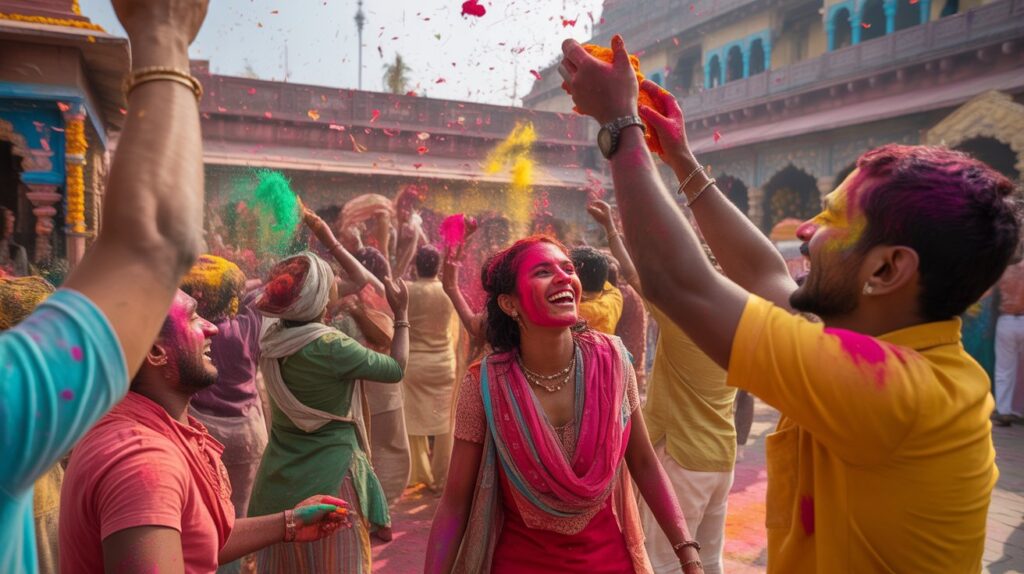
Pushkar is where Holi feels joyful rather than aggressive.
Why?
- Backpacker crowd
- Smaller town
- Friendlier atmosphere
- Guesthouses organize group Holi
- Spiritual yet relaxed vibe
- Open central square for celebrations
- Street music + dancing + color fights but with more respect
Pushkar gives you the energy of Holi without the feeling of being swallowed by a crowd.
You’ll meet:
- other solo travelers
- friendly locals
- musicians
- photographers
- artists
And most importantly — you’ll be surrounded by other people from around the world who are also celebrating for the first time.
Celebrating Holi in Delhi and Jaipur
In Delhi and Jaipur, Holi is more structured.
Many hotels, hostels, tourism groups host private Holi parties:
- controlled colors
- monitored entry
- safer crowds
- moderate alcohol use
- no random strangers grabbing you
These are ideal for those who want:
- the fun
- the color
- the music
- the dance
but don’t want:
- unpredictable behaviour
- unsafe touching
- aggression
For solo female travelers — Delhi & Jaipur hostel Holi events are often the best options.
The Psychological Side of Holi: It’s Not for Everyone
Many Indians themselves don’t like Holi.
And that’s okay.
Reasons include:
- allergies
- sensitive skin
- dislike of crowds
- introverted personality
- discomfort with strangers touching
- trauma from past Holi experiences
Some Indians stay home and watch movies.
Some go to temples.
Some just exchange dry gulal with family and that’s it.
You are NOT “missing the real India” if you don’t dive into street chaos.
Your version of Holi can be simple, safe, beautiful and personal.
Recommended Two-Week Itinerary for Backpackers Visiting During Holi
Here’s a realistic travel plan that flows and doesn’t burn you out:
Day 1–2: Arrive in Delhi
- rest
- adjust to India
- explore: Old Delhi, India Gate, local markets
- get a local SIM, cash, logistics sorted
Day 3: Agra
- Taj Mahal at sunrise
- Agra Fort
- optional: Mehtab Bagh sunset
Day 4–5: Jaipur
- Hawa Mahal
- Amber Fort
- Nahargarh Fort
- bazaars and street life
Day 6: Move to Pushkar
Prepare for Holi:
- modest, fully covered clothes
- sunglasses
- a bandana/scarf
- phone protection pouch
- remove contact lenses
Evening: relax by the lake.
Day 7: Celebrate Holi in Pushkar
Join a group celebration from your hostel or guesthouse.
You’ll experience colours, music, dancing — but with a vibe that is spirited, joyful and not threatening.
Day 8–9: Varanasi
Fly or train.
In Varanasi:
- walk the Ghats
- sunrise on the river
- evening Ganga aarti
- chai conversations with locals
- street food (carefully chosen)
Varanasi is intense but deeply moving — spiritual rather than chaotic.
Day 10–13: Himalayas (choose ONE)
Do NOT try to do multiple places. Choose one base:
- Manali
- Kasol
- Jibhi
- Dharamshala
- Bir
This is the decompression phase of the trip.
After Holi + cities + crowds + Varanasi — the mountains feel like therapy.
Day 14: Back to Delhi and fly home
Arrive with:
- memories
- photos
- stories
- and zero exhaustion
instead of returning home mentally fried.
Safety Tips for Holi (For Everyone)
These are essential:
- Play only with dry organic gulal
- Say no to hard/permanent colors
- Do not drink from strangers
- Keep a small group around you
- Wear full-cover clothing
- Protect eyes
And the biggest:
Trust your instincts.
If something feels off — it is.
Walk away.
Holi is fun — but you are not obligated to endure discomfort in the name of “culture”.
Additional Tips for Solo Female Travelers
- Always celebrate with a group
- Avoid street Holi in crowds
- Private events are better
- Stay hydrated & aware
- Pre-book safe accommodation
- Don’t hesitate to be firm
Indian women themselves often don’t go out for Holi — they celebrate privately.
Follow local women’s attitude — not influencers’ photos.
Budget Tips for Backpackers
During Holi, prices can rise in Mathura & Vrindavan.
Better options:
- Pushkar hostels
- Jaipur hostels
- Delhi backpacker stays
Average costs (approx.):
- Hostel beds: ₹450–₹1200
- Guesthouses: ₹900–₹3000
- Local meals: ₹80–₹250
- Street chai: ₹10–₹20
- Night train sleeper: ₹450–₹700
India can be extremely affordable if you eat local and travel smart.
Cultural Etiquette During Holi
Respect matters.
Use only dry powders — avoid smearing wet chemical colors on others.
Always ask: “Can I put color on you?”
If someone says NO — respect it immediately.
And remember:
Holi is not about attack.
It is about affection.
Final Thoughts: Make Holi Fit You, Not the Other Way Around
Your Holi experience should be:
- joyful
- safe
- liberating
- fun
- memorable
You don’t have to:
- get drenched
- be forcefully colored
- push through mobs
- participate in chaos
- do what others expect
Instead:
- choose your people
- choose your environment
- choose your comfort level
Pushkar for celebration, Varanasi for soul, Himalayas for silence — this combination creates a travel experience that is balanced, meaningful and unforgettable.
India is not a checklist.
India is an experience.
And the best way to enjoy it — is on your own terms.
Frequently Asked Questions
What is Holi and why is it celebrated?
Holi is the Hindu festival of colors that celebrates the victory of good over evil, the arrival of spring, and the joy of human connection.
It is based on the legend of Prahlad and the defeat of Holika, symbolizing how devotion and good always overcome evil.
What is the main reason to celebrate Holi?
The main reason to celebrate Holi is to mark the triumph of good over evil and to welcome the new season of spring, bringing renewal, positivity, and unity among people.
It’s a day of forgiveness, laughter, and breaking social barriers.
What do the Holi colors mean?
Each color used during Holi carries symbolism:
- Red — love & fertility
- Yellow — health & happiness
- Green — new beginnings & nature
- Blue — calmness & divinity (associated with Lord Krishna)
- Pink — joy & celebration
Together, the colors represent the diversity and vibrance of life.
What religion is Holi?
Holi is primarily a Hindu festival, but it is celebrated by people of many faiths in India and across the world due to its joyful and inclusive nature.
What food is eaten during Holi?
Popular Holi foods include:
- Gujiya – sweet dumplings filled with coconut & dry fruits
- Thandai – spiced milk drink (sometimes mixed with bhang)
- Malpua – sweet fried pancakes
- Dahi vada – lentil dumplings in yogurt
- Kachori & samosa – savory snacks
These foods reflect the sweetness and indulgence of the festival.
What are three facts about Holi?
Here are 3 strong, Holi facts:
- Holi dates change every year because it’s based on the Hindu lunar calendar (full moon of Phalguna).
- Holi is celebrated differently across regions — from Pushkar and Jaipur to Mathura and Vrindavan traditions.
- Holi promotes social unity, as people forgive old conflicts and restart relationships with positivity.
If you’re planning to visit India during Holi and want help with safe, guided or private celebrations, feel free to reach out — I help travelers find curated Holi experiences and authentic local stays.
Comments